
Blog

171 Results / Page 8 of 19

Background

todayMay 29, 2026

close

Blog Neerav Jindal

RAID in NVR: Why It Matters in Digital Forensics

Modern surveillance systems generate massive amounts of video data every day. From homes and offices to airports and smart cities, CCTV cameras continuously record footage that may later become critical evidence in investigations. To manage this large volume of data securely and efficiently, many Network Video Recorders (NVRs) use RAID ...

todayMay 29, 2026

close

Blog vanshika

History and Evolution of Fingerprint Analysis

Introduction  Fingerprint analysis is one of the oldest and most reliable methods of personal identification used in criminal investigations. Every individual possesses unique fingerprint patterns that remain unchanged throughout life, making fingerprints a powerful tool in forensic science. Over centuries, fingerprint analysis has evolved from simple observations of skin patterns ...

todayMay 27, 2026

close

Blog Neerav Jindal

Web Browser Artifacts in Digital Forensics

  Introduction Web browsers have become one of the most frequently used applications on modern computers and mobile devices. Every website visit, login session, search query, and download leaves behind traces known as web browser artifacts. In digital forensics, these artifacts play a crucial role in reconstructing user activity, identifying ...

todayMay 27, 2026

close

Blog vanshika

Types of Evidence in Criminal Investigations

Introduction In every criminal investigation, evidence plays a crucial role in uncovering the truth, identifying suspects, and ensuring justice. Evidence helps investigators reconstruct events, establish links between victims and suspects, and present reliable facts in court. Without proper evidence, even the most serious crimes can remain unsolved. From fingerprints and ...

todayMay 26, 2026

close

Blog Neerav Jindal

File Allocation Methods: The Backbone of Data Storage

Every file stored on a computer occupies space on a storage device such as a hard disk or SSD. But have you ever wondered how the operating system keeps track of where each file is stored? This is where file allocation methods come into play. These methods define how files ...

todayMay 25, 2026

close

Blog vanshika

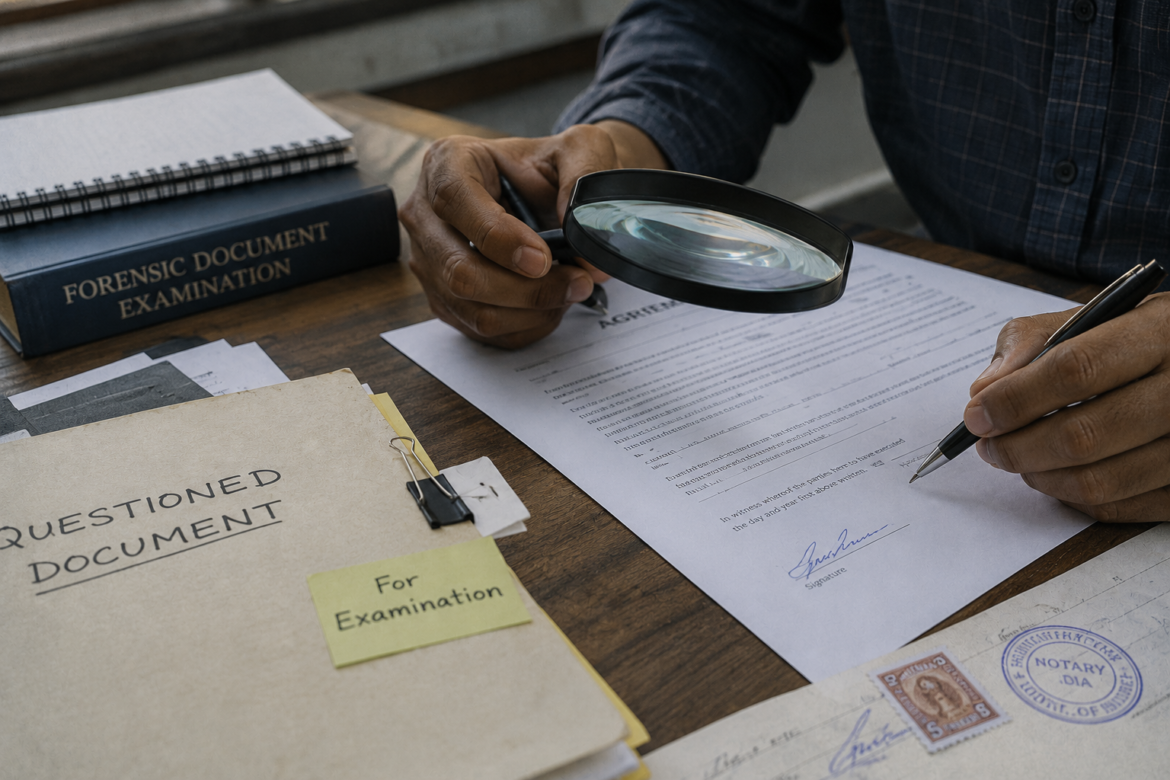
The Science Behind Signature Verification

Introduction Signatures have long been used as a symbol of identity, consent, and authorisation. From banking transactions and legal agreements to passports and business contracts, signatures continue to play a vital role in everyday life. However, with the increasing cases of forgery and document fraud, verifying the authenticity of signatures ...

todayMay 25, 2026

close

Blog Neerav Jindal

Photomicrography vs Microphotography: What’s the Difference?

In forensic science, precision documentation plays a critical role in evidence examination and courtroom presentation. Two terms often confused in imaging science are photomicrography and microphotography. Although they sound similar, they refer to entirely different processes. Understanding the distinction is essential, especially in questioned document examination, trace evidence analysis, and ...

todayMay 23, 2026

close

Blog vanshika

Common Mistakes That Destroy Crime Scene Evidence

Introduction Crime scene evidence plays a crucial role in modern criminal investigations. Every fingerprint, bloodstain, footprint, digital device, or handwritten note collected from a scene has the potential to uncover the truth and help investigators reconstruct events accurately. However, evidence is extremely fragile. A single mistake at the crime scene ...

todayMay 22, 2026

close

Blog Neerav Jindal

MBR vs GPT in Digital Forensics: Understanding Disk Partition Structures

In digital forensics, understanding disk partitioning schemes is essential for accurate evidence acquisition, analysis, and recovery. Two of the most common partitioning standards encountered during forensic investigations are MBR (Master Boot Record) and GPT (GUID Partition Table). Although both define how data is organized on storage devices, they differ significantly ...