Modern smartphones store vast amounts of digital evidence, including messages, call logs, photos, application data, and system artifacts. As a result, mobile devices often become critical sources of information during digital investigations. However, investigators do not always gain easy access to this data.
In many cases, devices may be locked, damaged, or intentionally manipulated to prevent access. Consequently, standard forensic tools sometimes fail to retrieve the necessary evidence. When this happens, investigators rely on advanced hardware-level extraction techniques.
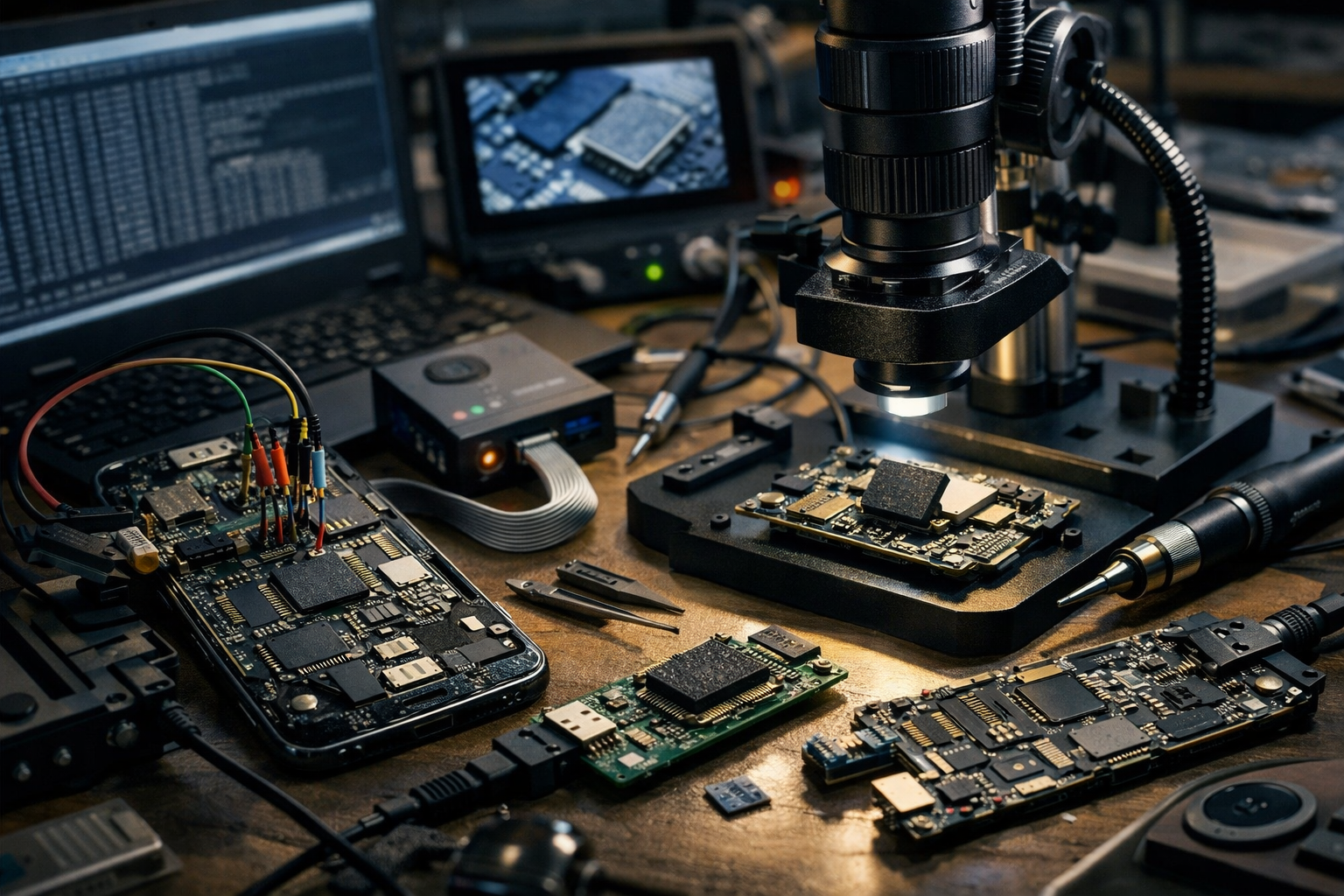
Among the most important methods are JTAG, Chip-off, and ISP (In-System Programming) extraction. These techniques allow forensic specialists to access data directly from a device’s memory. Although they require specialized tools and technical expertise, they can recover valuable evidence when other methods cannot.
Why Advanced Extraction Techniques Are Necessary
Traditional mobile forensic tools typically perform logical or file system extraction. These methods work well when the device functions normally and investigators can interact with the operating system.
However, several situations can limit these standard approaches. For example:
-
The device may be physically damaged
-
The phone may be locked or inaccessible
-
The operating system may be corrupted
-
Anti-forensic techniques may attempt to hide or destroy evidence
Therefore, investigators often turn to hardware-level extraction methods. These techniques bypass the operating system and interact directly with the device’s memory.
JTAG Extraction
JTAG (Joint Test Action Group) extraction is a hardware-based technique that allows investigators to read data directly from a device’s memory through the JTAG interface on the motherboard.
How JTAG Works
Manufacturers include JTAG test access ports in many electronic devices to assist with debugging and hardware testing. Investigators can use these same interfaces to retrieve memory data.
Typically, the process involves the following steps:
-
Disassemble the mobile device carefully
-
Locate the JTAG test points on the circuit board
-
Connect a specialized JTAG controller
-
Extract a raw memory dump from the device
Afterward, forensic software analyzes the extracted memory image to identify files and artifacts.
Advantages of JTAG
First, JTAG extraction can recover large portions of device memory. Additionally, it can work even when the operating system fails to boot. Furthermore, it remains less destructive than chip-off extraction, since the memory chip stays attached to the motherboard.
Limitations of JTAG
However, JTAG extraction also presents challenges. Investigators must correctly identify the test points on the board, which can be difficult. In addition, some modern devices no longer expose accessible JTAG interfaces. Finally, the extraction process can be slow and technically demanding.
Chip-Off Extraction
Chip-off extraction represents one of the most powerful methods in mobile device forensics. In this technique, investigators remove the memory chip from the device’s motherboard and read it directly using specialized hardware.
How Chip-Off Works
The chip-off process usually follows several steps:
-
Heat the motherboard carefully
-
Remove the flash memory chip from the board
-
Clean and prepare the chip for analysis
-
Insert the chip into a specialized reader to extract the data
Once investigators obtain the raw memory image, forensic tools analyze the data to recover files, deleted artifacts, and system information.
Advantages of Chip-Off
Chip-off extraction offers several benefits. For instance, investigators can recover data from severely damaged devices. Moreover, the method can reveal deleted or hidden information stored in flash memory. Most importantly, investigators can still retrieve data even if the device cannot power on.
Limitations of Chip-Off
Despite its advantages, chip-off extraction carries significant risks. The process is highly destructive, which means the device will no longer function afterward. Additionally, the procedure requires specialized laboratory equipment and advanced technical skills. If investigators handle the chip improperly, they may permanently damage the stored data.
Because of these risks, forensic professionals usually treat chip-off as a last-resort extraction method.
ISP (In-System Programming) Extraction
ISP extraction provides a useful alternative between JTAG and chip-off techniques. Instead of removing the memory chip, investigators access it directly while it remains attached to the motherboard.
How ISP Works
Investigators first identify test points connected to the memory chip. Next, they attach fine probes or solder small wires to these points. Then, they connect a forensic reader that communicates directly with the memory chip.
As a result, investigators can extract data without removing the chip from the device.
Advantages of ISP
ISP extraction offers several important advantages. First, it is less destructive than chip-off extraction. Second, it often allows faster data acquisition than JTAG. Finally, investigators do not need to remove the memory chip, which reduces the risk of hardware damage.
Limitations of ISP
However, ISP extraction still requires precision and expertise. Investigators must accurately identify the correct connection points on the motherboard. Furthermore, some devices include hardware security protections that limit this technique.
Challenges in Hardware-Level Data Extraction
Although these techniques provide powerful capabilities, investigators still face several challenges.
First, modern smartphones often use strong encryption, which can limit access to readable data even after extraction. Additionally, device manufacturers continue to miniaturize hardware components, making physical access more difficult.
Furthermore, improper handling can damage the memory chip and destroy valuable evidence. Therefore, investigators must follow strict forensic procedures to maintain evidence integrity.
Conclusion
Advanced extraction techniques such as JTAG, Chip-off, and ISP play a crucial role in mobile device forensics. When standard forensic tools fail, these methods allow investigators to access data directly from device memory.
However, these techniques require specialized knowledge, precise handling, and professional forensic equipment. For this reason, trained forensic experts typically perform these procedures in controlled laboratory environments.
As mobile technology continues to evolve, forensic investigators must continually adapt their methods. Ultimately, these advanced techniques ensure that critical digital evidence remains accessible—even in the most challenging investigative scenarios.




Post comments (0)