A damaged pen drive can become inaccessible without warning. The device may not appear on a computer, show an incorrect storage capacity, ask to be formatted, or contain files that cannot be opened. While conventional data recovery methods may sometimes help, damaged pen drive data recovery becomes significantly more complex when the storage device contains important or potentially evidentiary data.
In forensic examinations, the objective is not simply to recover files. The process must preserve the integrity of the available data, document every step, and, where possible, create a forensic image that can be examined without modifying the original device.
Why Is Pen Drive Data Recovery Difficult?
USB flash drives use NAND flash memory and a controller to manage how data is stored and accessed. Physical damage, controller failure, corrupted file systems, accidental formatting, malware, improper removal, or logical corruption can make the data inaccessible.
Some common symptoms include:
- Pen drive not detected by the operating system
- Device detected but showing 0 bytes
- Incorrect or unusual storage capacity
- Files and folders disappearing
- File-system corruption
- USB device repeatedly connecting and disconnecting
- Files appearing with corrupted names or extensions
- The operating system requesting a format
The recovery approach depends heavily on whether the problem is logical damage, physical damage, controller failure, or flash-memory-related corruption.
Forensic Approach to Damaged Pen Drive Recovery
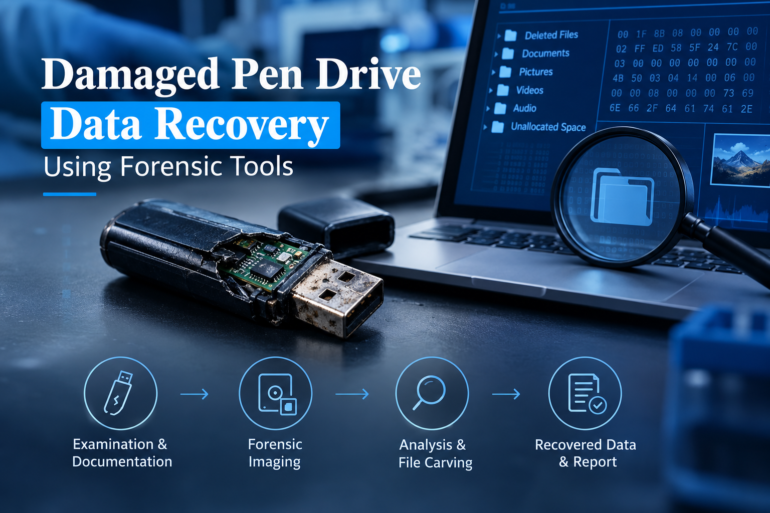
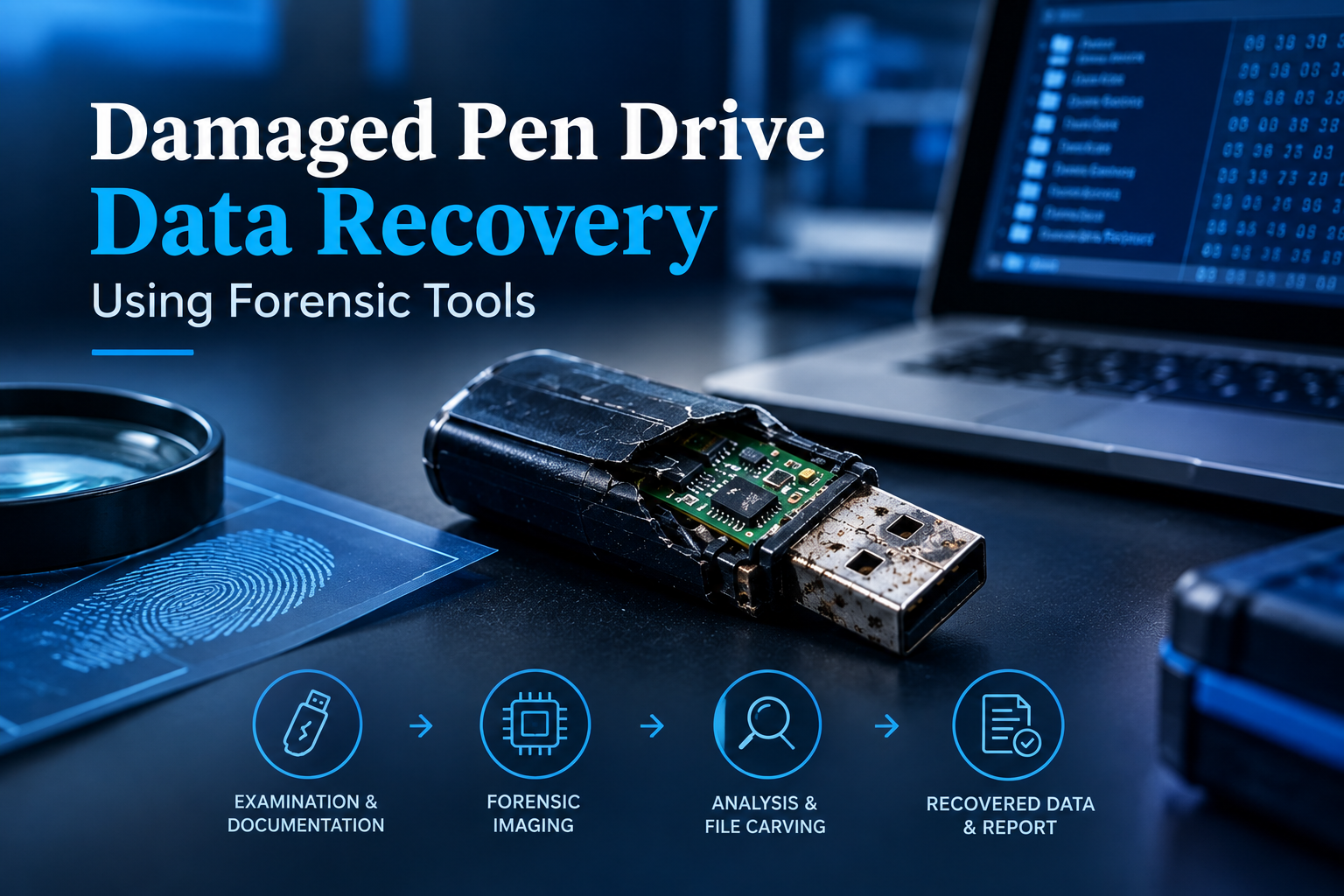
Forensic recovery should begin with documentation and examination rather than immediately attempting repairs.
The examiner records the device’s make, model, serial number, storage capacity, physical condition, and other identifying information. Photographs may also be taken to document the original condition.
The next step is controlled acquisition. If the device is accessible, a forensic image can be created so that subsequent analysis can be performed on a copy rather than the original media.
Tools such as FTK Imager, Autopsy, and other specialist forensic acquisition and analysis tools can assist depending on the condition of the evidence.
FTK Imager information from Exterro
Creating a Forensic Image
A forensic image is a bit-by-bit representation of the accessible contents of the storage media. When possible, imaging is preferred over directly examining or modifying the original pen drive.
During acquisition, the examiner may calculate cryptographic hash values such as MD5 or SHA-256. These values help establish that the acquired image has not been unintentionally altered during examination.
However, severely damaged devices may not allow a conventional imaging process to complete. In such cases, the examiner may need to use specialized hardware or forensic acquisition techniques to obtain as much data as possible.
Analysing the Recovered Image
Once an image has been successfully acquired, forensic tools can be used to examine its contents.
Depending on the file system and condition of the image, an examiner may search for:
- Deleted files
- Existing documents and media
- File-system metadata
- File signatures
- Partially corrupted files
- Unallocated space
- File fragments
- Hidden or renamed files
- Previously stored directory structures
For example, if the file system is severely corrupted, file carving may be used. File carving identifies files based on their internal signatures rather than relying entirely on the damaged directory structure.
Specialized forensic platforms such as Autopsy can assist with file-system analysis and recovery workflows.
Autopsy Digital Forensics Platform
What If the Pen Drive Is Physically Damaged?
Physical damage requires additional caution.
If a pen drive has a broken connector, damaged PCB, controller failure, or flash-memory problem, repeatedly connecting it to a computer can potentially make the situation worse.
A forensic or specialist laboratory may first determine whether the flash memory itself is accessible. Depending on the device architecture, advanced recovery may involve specialized hardware, chip-level techniques, or reconstruction of the NAND data.
It is important to understand that forensic data recovery from a damaged pen drive is not always guaranteed. The possibility of recovery depends on the type and extent of damage, the condition of the memory chips, and whether the underlying data has been overwritten.
Why You Should Avoid DIY Recovery
When valuable or legally relevant information is stored on a damaged pen drive, experimenting with multiple recovery applications can introduce unnecessary risks.
Formatting the device, running file-system repair utilities, writing recovered files back to the same media, or repeatedly reconnecting a malfunctioning device may complicate later forensic examination.
A better approach is to preserve the original device and allow a qualified examiner to assess it before recovery attempts are made.
Forensic Recovery vs. Regular Data Recovery
The major difference is the purpose and methodology.
Regular data recovery primarily focuses on retrieving usable files. Forensic data recovery, on the other hand, focuses on recovering information while maintaining evidence integrity and documenting the examination process.
Where recovered information may be used in an investigation or legal proceeding, documentation, acquisition methodology, hashing, examination notes, and reporting become particularly important.
Final Thoughts
Damaged pen drive data recovery using forensic tools requires more than simply running a recovery program. The examiner must first determine the nature of the damage, preserve the original evidence, acquire data using an appropriate forensic methodology, and then analyse the resulting image using suitable tools.
Whether the issue is accidental deletion, file-system corruption, formatting, or physical failure, early and careful handling can make a significant difference.
For important or potentially evidentiary data, avoid unnecessary modifications to the damaged pen drive. A controlled forensic examination provides a more reliable approach to determining what information can still be recovered and what evidence may remain available.



Post comments (0)