When you use a smartphone, you may hear terms such as SIM card storage, phone memory, internal storage, and RAM. Although these technologies work together to make a phone functional, they serve very different purposes. Understanding the difference between a SIM card and phone memory is particularly important not only for everyday smartphone users but also for anyone interested in mobile device forensics and digital evidence investigation.
What Is a SIM Card?
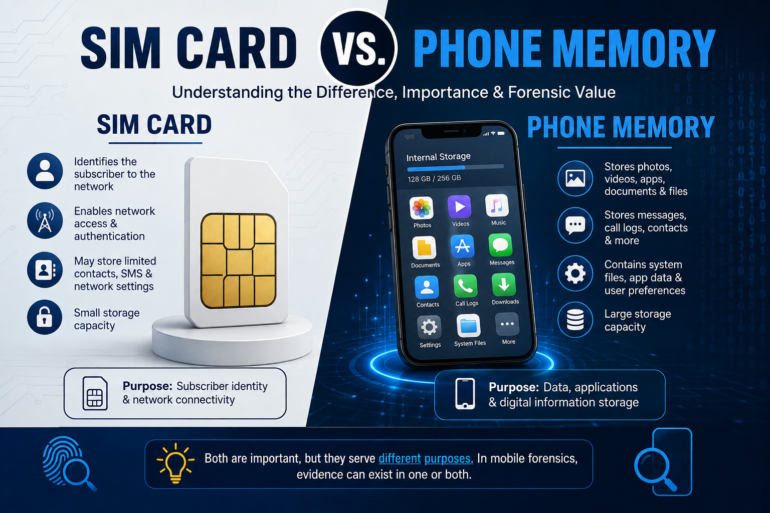
A SIM (Subscriber Identity Module) card is a small chip that primarily identifies a mobile subscriber to a cellular network. It contains information that allows the device to connect to the network and authenticate the subscriber.
Depending on the SIM type and network configuration, a SIM may also store limited information such as:
- Subscriber identity information
- Network authentication data
- Contacts
- SMS messages on some older devices
- Network-related settings
Modern smartphones generally rely much more heavily on the phone’s internal storage for contacts, messages, applications, photographs, and other data.
It is also important to understand that a SIM card is not the same as a phone’s internal storage. Removing a SIM card does not normally remove the data stored on the smartphone itself.
What Is Phone Memory?
The term phone memory is commonly used to describe the storage available within a smartphone. Modern phones typically use flash storage, such as UFS or eMMC, to store user and system data.
Internal storage may contain:
- Photos and videos
- Applications and application databases
- Documents
- Downloaded files
- Call logs
- Contacts
- Messages
- Browser data
- System files
- Application cache and other artifacts
The amount of internal storage varies considerably between devices. A smartphone might have 64 GB, 128 GB, 256 GB, 512 GB, or more.
When someone says, “My phone memory is full,” they are generally referring to internal storage, not the SIM card.
SIM Card vs. Phone Memory: Key Differences
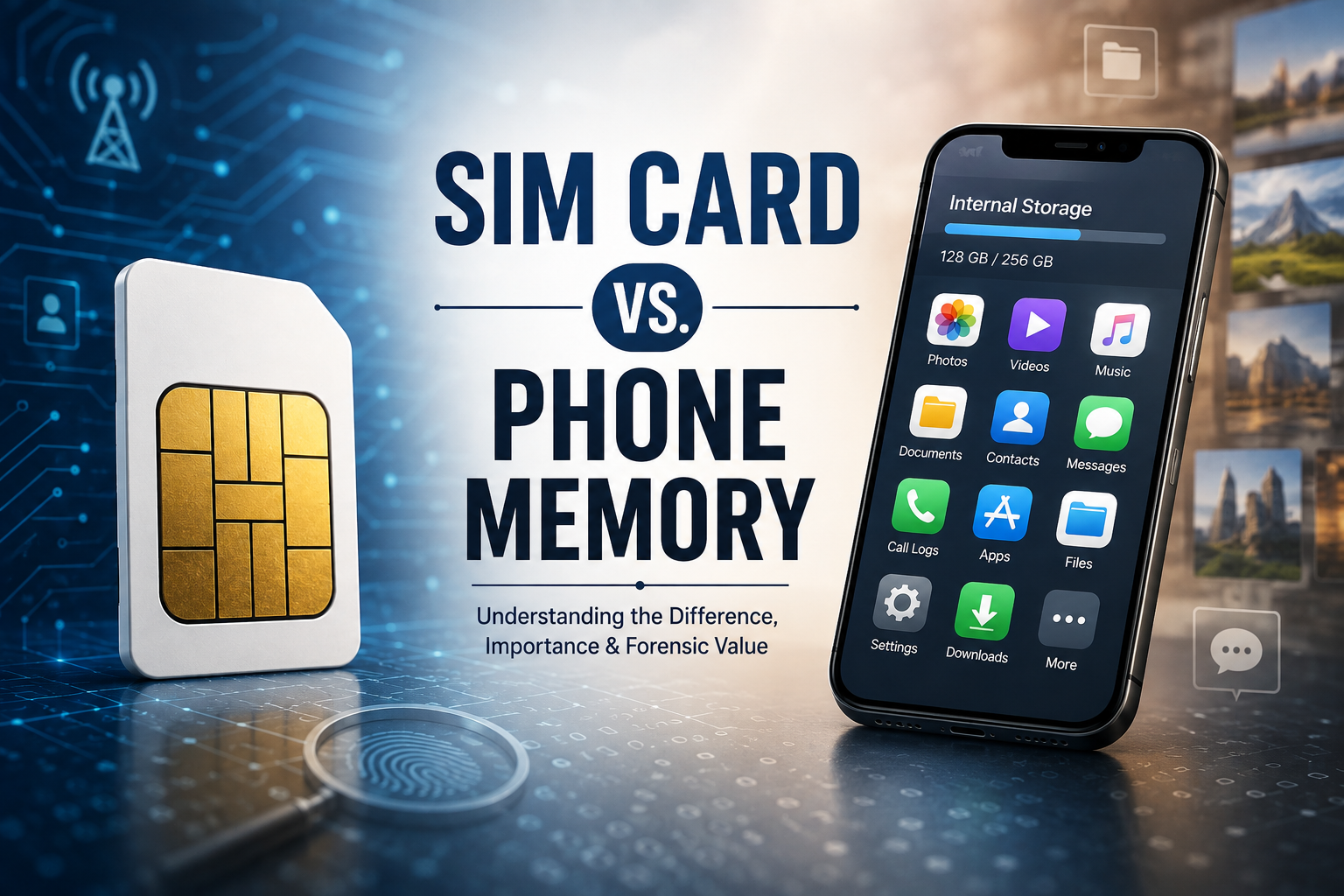
The most important difference between a SIM card and phone memory is their purpose.
A SIM card primarily relates to subscriber identification and cellular network access, whereas internal phone storage is designed to store the operating system, applications, user files, and application-generated data.
| Feature |
SIM Card |
Phone Memory |
| Primary purpose |
Subscriber/network identification |
Data and application storage |
| Storage capacity |
Very limited |
Much larger |
| Stores apps |
Generally no |
Yes |
| Stores photos/videos |
Generally no |
Yes |
| Stores messages |
Limited/older implementations |
Yes |
| Stores contacts |
May store some |
Yes |
| Removable |
Usually yes, for physical SIMs |
Generally no |
| Forensic value |
Subscriber/network-related artifacts |
Extensive user and application data |
Why Does This Difference Matter in Mobile Forensics?
The distinction becomes particularly important during a mobile forensic investigation.
An investigator should not assume that all relevant evidence is stored on the SIM card. In modern smartphones, significant amounts of potentially relevant evidence may exist in internal storage, application databases, cloud-synchronized data, removable media, or other components.
For example, a WhatsApp conversation is generally not simply “stored on the SIM.” Relevant WhatsApp artifacts are associated with the application and device storage, along with potentially associated cloud backups.
Similarly, photographs, videos, browser history, application data, and downloaded documents are normally found within the device’s storage rather than on the SIM.
For professionals conducting mobile device forensic examination, understanding the device’s storage architecture is therefore essential.
The National Institute of Standards and Technology (NIST) Mobile Device Forensics resources provide useful guidance and research related to the forensic examination of mobile devices.
Can a SIM Card Contain Deleted Data?
A SIM card can contain certain categories of information, but its storage capacity and data structure are substantially different from modern smartphone internal storage.
Depending on the SIM implementation, deleted contacts or SMS records may sometimes leave recoverable remnants. However, the possibility and extent of recovery depend on the SIM technology, available records, overwriting, device behavior, and forensic acquisition method.
This is one reason forensic examination should be performed systematically rather than assuming that a single storage component contains all available evidence.
Is Phone Memory the Same as RAM?
Another common source of confusion is the difference between storage memory and RAM.
RAM (Random Access Memory) is temporary working memory used by the operating system and applications while the device is running. Internal storage, on the other hand, retains data when the device is powered off.
For example, a phone advertised as having 8 GB RAM and 256 GB storage has two different memory resources:
- 8 GB RAM: Temporary working memory
- 256 GB storage: Persistent storage for applications and user data
Therefore, SIM storage, RAM, and internal storage are three different concepts.
Why Users Should Understand the Difference
Knowing the difference between SIM card and phone memory can help users troubleshoot storage problems, understand what happens when they change SIM cards, and protect their data.
It is also highly relevant to cybersecurity and digital investigations. A SIM card change does not automatically mean that the previous device data has disappeared. Similarly, removing a SIM card does not necessarily remove locally stored messages, photographs, application artifacts, or other digital evidence.
For more technical guidance on mobile device security and digital evidence, the CISA Cybersecurity Resources provide useful cybersecurity information.


Post comments (0)