What Is Chip-Off and JTAG in Mobile Forensics?
Recovering data from damaged or locked smartphones often requires techniques beyond standard forensic extraction. When logical, file system, or even physical extraction is not possible through software tools, forensic experts turn to advanced mobile forensic acquisition methods such as Chip-Off and JTAG.
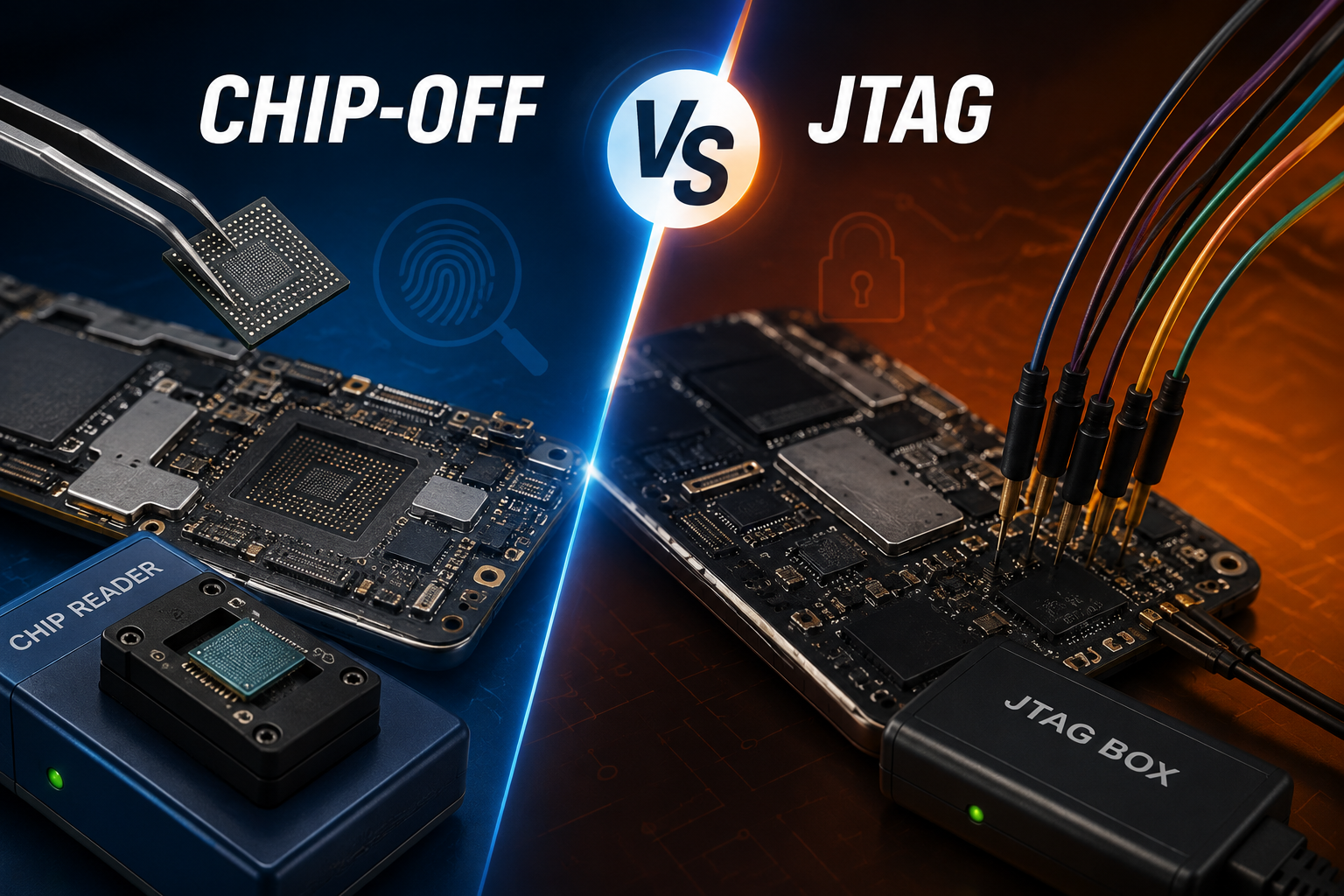
Both techniques are designed to extract data directly from a device’s hardware, but they differ significantly in complexity, risk, and use cases. Understanding Chip-Off vs JTAG mobile forensics is essential for investigators handling critical digital evidence.
NIST Computer Forensics Guidelines: NIST Computer Forensics Tool Testing Program
What Is JTAG Forensic Acquisition?
JTAG (Joint Test Action Group) is a hardware-based forensic acquisition method that accesses a device’s memory through dedicated debugging ports built into the circuit board. Instead of removing the memory chip, investigators connect specialized forensic equipment to the device’s test points and communicate directly with the processor.
How JTAG Works
-
The device is carefully disassembled.
-
JTAG test points on the motherboard are identified.
-
Fine probes or soldered connections are attached.
-
Specialized forensic hardware reads the memory through the debugging interface.
-
The extracted data is analyzed using forensic software.
Advantages of JTAG
-
Preserves the original memory chip.
-
Less destructive than Chip-Off.
-
Can recover deleted data in some supported devices.
-
Useful for damaged phones that still have functioning hardware interfaces.
Limitations of JTAG
-
Many modern smartphones disable or secure JTAG access.
-
Requires precise soldering skills.
-
Test points may be undocumented or difficult to locate.
-
Not effective on all device models.
This means that even if investigators successfully extract raw memory, decrypting the data may not always be possible without the original hardware or authentication credentials. The National Institute of Standards and Technology (NIST) publishes forensic testing guidelines through its Computer Forensics Tool Testing (CFTT) Program , which helps forensic laboratories validate their tools and maintain reliable evidence-handling practices.
What Is Chip-Off Forensic Acquisition?
Chip-Off is one of the most advanced and invasive mobile forensic acquisition methods. In this process, the flash memory chip (such as eMMC, eMCP, or UFS) is physically removed from the device’s motherboard and read using a specialized memory chip reader.
Unlike JTAG, Chip-Off completely bypasses the phone’s processor and operating system.
How Chip-Off Works
-
The smartphone is disassembled.
-
Heat is carefully applied using professional rework equipment.
-
The memory chip is removed without damaging its internal structure.
-
The chip is cleaned and placed into a compatible forensic adapter.
-
A forensic chip reader extracts the raw memory contents.
-
The recovered image is analyzed using forensic software.
Advantages of Chip-Off
-
Works even when the device is completely dead.
-
Bypasses damaged processors and operating systems.
-
Can recover data from severely damaged phones.
-
Useful when other acquisition methods fail.
Limitations of Chip-Off
-
-
Requires expensive laboratory equipment.
-
Modern encryption can render extracted data unreadable.
-
Mistakes during removal can permanently destroy evidence.
Chip-Off vs JTAG: Key Differences
|
Feature
|
JTAG
|
Chip-Off
|
|
Memory Chip Removed
|
No
|
Yes
|
|
Destructive
|
Minimal
|
Highly invasive
|
|
Difficulty
|
High
|
Very High
|
|
Equipment
|
JTAG Box
|
Rework Station + Chip Reader
|
|
Best For
|
Partially functional devices
|
Completely damaged devices
|
|
Encryption Bypass
|
No
|
No
|
When Do Forensic Experts Choose Each Method?
JTAG Is Preferred When
-
The device powers partially.
-
Debug ports remain accessible.
-
Non-destructive acquisition is preferred.
-
Investigators want to preserve hardware integrity.
Chip-Off Is Preferred When
-
The phone is completely non-functional.
-
The motherboard is damaged but the memory chip remains intact.
-
Other forensic extraction methods have failed.
-
The investigation involves high-value evidence that justifies invasive recovery.
Challenges in Modern Mobile Forensics
Today’s smartphones present significant obstacles for both Chip-Off forensic methods and JTAG data extraction.
Manufacturers now implement:
-
-
Secure Enclave or Trusted Execution Environments
-
Hardware-backed encryption keys
-
Disabled debugging interfaces
-
Tamper-resistant memory designs
This means that even if investigators successfully extract raw memory, decrypting the data may not always be possible without the original hardware or authentication credentials.
Organizations such as the National Institute of Standards and Technology (NIST) publish guidance on forensic methodologies and digital evidence handling that helps laboratories maintain reliable investigative practices.
Why These Techniques Require Specialized Expertise
Both Chip-Off and JTAG demand more than technical knowledge—they require laboratory-grade precision. A single mistake while soldering or heating a memory chip can permanently destroy valuable evidence.
Professional forensic laboratories combine these hardware techniques with:
-
Chain of custody procedures
-
-
-
Validation of forensic tools
-
Repeatable examination workflows
This ensures that recovered digital evidence remains reliable for investigative and legal purposes.



![[Mobile Forensics] 휴대폰 메모리에 대하여](https://images.openai.com/static-rsc-4/uOYeFc-TQ7tHmX8LoXVGuH7K6orBT_uGgeXgPSpNaCqLGm5BMvxXNgL8OGcJzVRPLbR3u9FMu90sHH7HQ3Pqcefo1nBpPyuAxHjBboEoNHQLkuUet-Op9jepFnf0q0oDJONFsmELWvChhGSCc5BnidSXUIzrD-laq-OZv4aXCxw?purpose=inline)


Post comments (0)