When a dead body is discovered, insects found on or around the remains can provide important forensic information. Flies, beetles, maggots, and other arthropods are not simply a consequence of decomposition. Their presence, species, and developmental stages can help investigators understand when, where, and under what conditions decomposition occurred.
The scientific study of insects associated with decomposing remains is known as forensic entomology. It is particularly valuable when conventional methods of estimating the time since death become less reliable.
What Do Insects on a Cadaver Indicate?
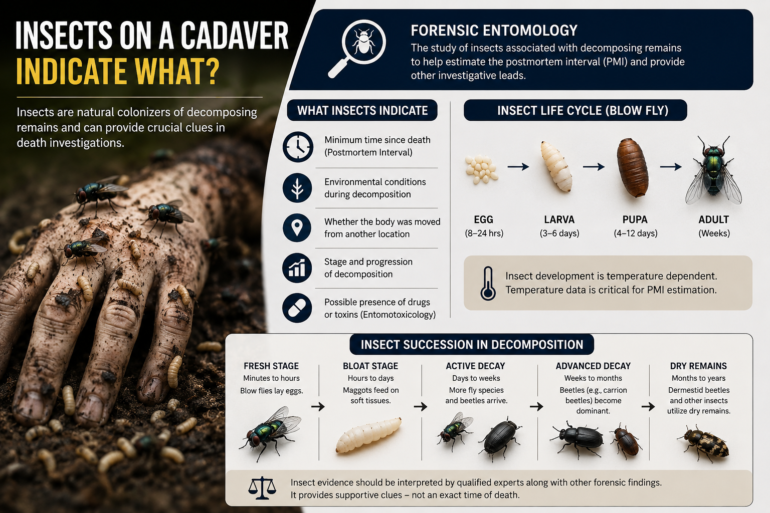
Insects on a cadaver can provide information about several aspects of a death investigation. Most importantly, they may assist in estimating the postmortem interval (PMI)—the period that has elapsed since death.
However, insect evidence does not always establish the exact time of death. In many cases, forensic entomologists estimate the minimum postmortem interval (minPMI) based on the age of the oldest insects associated with the remains.
Insect evidence may also help investigators assess:
- The approximate minimum time since death
- The stage and progression of decomposition
- Whether remains may have been moved
- Environmental conditions surrounding decomposition
- Possible concealment or delayed insect access
- Certain forms of trauma or wound-associated insect activity
- The possible presence of drugs or toxins in decomposed remains
How Do Insects Reach a Dead Body?
After death, decomposition produces volatile organic compounds and characteristic odors. Certain insects can detect these chemical signals and may locate exposed remains rapidly under favorable conditions.
Blow flies (family Calliphoridae) are among the most important early colonizers. Adult female flies may deposit eggs, or in some species larvae, in moist and protected areas such as the nose, mouth, eyes, wounds, and other body openings.
The resulting larvae, commonly called maggots, feed on decomposing tissue and progress through predictable developmental stages.
Because insect development is strongly influenced by temperature, forensic entomologists can combine information about the species, developmental stage, and environmental temperature to estimate how long the insects have been developing.
Insect Life Cycle and Postmortem Interval
A typical blow fly life cycle includes:
Egg → Larva → Pupa → Adult fly
The larval period generally consists of three instars. Investigators may examine larval size, developmental stage, pupal characteristics, and species identity.
Temperature data are especially important because insects are ectothermic—their development depends heavily on environmental temperature. Specialists may use thermal accumulation models such as accumulated degree hours (ADH) or accumulated degree days (ADD) when estimating insect age.
For example, finding mature larvae or pupae may indicate a longer period of insect development than finding recently deposited eggs. The interpretation must still account for species, temperature, weather, access to the body, and other variables.
Insect Succession During Decomposition
Different insects tend to colonize remains at different stages of decomposition. This process is known as insect succession.
Flies such as blow flies and flesh flies are commonly associated with relatively early decomposition. As decomposition progresses, other groups—including various beetles—may become increasingly important.
Carrion beetles, rove beetles, hister beetles, and dermestid beetles can be associated with particular decomposition environments or stages.
This succession pattern can provide useful information, particularly when remains have been decomposing for an extended period. However, succession varies according to geographic region, season, habitat, temperature, and local insect populations. Local scientific data are therefore important.
Can Insects Show That a Body Was Moved?
Potentially, yes.
The insect species associated with remains may sometimes provide clues about the environment in which decomposition occurred. If the insect assemblage is inconsistent with the location where the body was recovered, investigators may consider whether the remains were previously located elsewhere.
For example, species strongly associated with a particular habitat may raise questions when recovered from remains in a substantially different environment.
This evidence must be interpreted carefully and alongside crime-scene findings, pathology, environmental data, and other forensic evidence. Insects alone should not be treated as definitive proof that a body was moved.
What Is Forensic Entomotoxicology?
Insects can sometimes contribute to toxicological investigations as well.
Forensic entomotoxicology examines drugs, poisons, or other substances in insects feeding on decomposing remains and also studies how those substances may influence insect development.
This can be useful when conventional biological samples such as blood are unavailable or severely degraded. Larvae or other insect specimens may potentially contain evidence of substances to which they were exposed while feeding.
Importantly, drugs and toxins can also alter insect growth rates. If this effect is ignored, it may influence estimates based on insect development.
Factors That Affect Insect Evidence
The presence and development of insects do not depend on time alone. Environmental and scene-specific factors can substantially affect colonization.
Temperature is one of the most significant variables, but rainfall, humidity, season, sunlight, clothing, burial, wrapping, enclosure, indoor versus outdoor location, insect accessibility, and geographic region may all influence the evidence.
For this reason, forensic entomology requires proper collection, preservation, documentation, species identification, and environmental assessment.
Investigators may collect both live and preserved specimens because they serve different purposes. Scene photographs, body temperature observations where applicable, ambient temperature records, weather data, and precise collection locations can also be important for subsequent interpretation.
Why Is Forensic Entomology Important?
In advanced decomposition, traditional indicators used to estimate the postmortem interval may become increasingly limited. Insect evidence can therefore become an important component of the death investigation.
Forensic entomology does not simply answer the question, “Are insects present?” Instead, specialists examine which insects are present, their developmental stages, when they could have colonized the remains, and whether the insect evidence is consistent with the circumstances of the scene.
When collected and interpreted scientifically, insects associated with a cadaver can provide valuable evidence concerning minimum time since death, decomposition history, environmental exposure, and potentially the circumstances surrounding the remains.
For further scientific information, explore resources from the American Board of Forensic Entomology and the National Institute of Standards and Technology (NIST).



Post comments (0)