CCTV cameras are now present almost everywhere. They are commonly installed in homes, offices, shops, banks, parking areas, roads, and other public places. As a result, CCTV footage has become an important source of evidence in many criminal investigations.
However, simply obtaining CCTV footage is not enough. Investigators must collect, preserve, examine, and interpret it correctly. This is where CCTV Forensics in Criminal Cases plays an important role.
CCTV forensics helps investigators examine video recordings scientifically. It can help establish a timeline, track a person or vehicle, reconstruct an incident, and identify important details captured by surveillance cameras.
What is CCTV Forensics?
CCTV forensics is a branch of digital video forensics. It involves the scientific examination of video recordings obtained from CCTV cameras and surveillance systems.
These recordings may be stored on a Digital Video Recorder (DVR), Network Video Recorder (NVR), memory card, hard drive, or cloud-based system.
A CCTV forensic expert does much more than simply watch the footage. The expert may extract the original recording, examine individual frames, verify timestamps, analyze metadata, enhance relevant portions, and check the integrity of the video.
Proper forensic examination is important because CCTV recordings can be affected by low resolution, compression, missing frames, incorrect timestamps, poor lighting, or improper exporting.
Importance of CCTV Forensics in Criminal Cases
The use of CCTV Forensics in Criminal Cases has increased significantly in recent years. Surveillance footage can provide an independent visual record of an incident.
For example, CCTV footage may show when a person entered or left a particular location. It may also show the movement of a suspect, interaction between individuals, movement of vehicles, or objects carried by a person.
Therefore, CCTV video evidence analysis can be useful in cases involving theft, robbery, assault, burglary, road accidents, vandalism, missing persons, and many other incidents.
However, CCTV footage should always be examined carefully. Investigators should also compare it with other available evidence before reaching a conclusion.
Identification and Tracking of Suspects
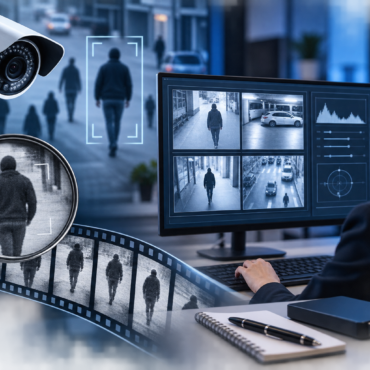
One of the common uses of forensic CCTV analysis is to track persons who may be connected with an incident.
Depending on the quality of the recording, CCTV footage may show a person’s clothing, approximate physical appearance, accessories, gait, direction of movement, or objects being carried.
Investigators may also examine footage from several CCTV cameras. This can help them track the movement of a person from one location to another.
In some cases, facial details may also be available for examination. However, facial identification depends heavily on the quality of the footage.
Poor lighting, low resolution, motion blur, camera angle, distance, and video compression can reduce the amount of visible detail. Therefore, forensic conclusions should always remain within the limitations of the available footage.
Vehicle Identification Through CCTV Footage
CCTV footage can also provide useful information when a vehicle is involved in a crime.
A forensic examiner may look for details such as the vehicle type, colour, registration number, stickers, damage, accessories, or direction of travel.
Individual video frames may also be extracted for detailed examination. If enough information is available in the original footage, enhancement techniques may improve the visibility of a registration plate or another vehicle feature.
Recordings from different CCTV cameras can also help investigators reconstruct the possible route taken by a vehicle.
Timeline Reconstruction Using CCTV Evidence
Establishing the sequence of events is an important part of a criminal investigation. CCTV recordings can help investigators understand what happened before, during, and after an incident.
A CCTV forensic examination may involve reviewing the footage frame by frame. Recordings from different cameras can also be compared to create a more complete timeline.
However, investigators should not automatically assume that the time displayed on CCTV footage is correct.
A DVR or NVR may have an incorrect system time because of configuration errors, power failures, clock drift, or incorrect date and time settings.
Therefore, CCTV timestamps should be verified before they are used to establish an exact timeline.
CCTV Footage Enhancement and Frame Analysis
CCTV recordings are not always clear. Poor lighting, low-quality cameras, motion, distance, and video compression can make important details difficult to see.
In such situations, CCTV footage enhancement techniques may be used.
Common techniques include brightness and contrast adjustment, noise reduction, frame extraction, image stabilization, enlargement, sharpening, and frame-by-frame examination.
However, enhancement has an important limitation.
Forensic enhancement cannot create genuine details that were never captured by the original camera.
Therefore, enhancement should only improve the visibility of information that already exists in the recording. It should not introduce or artificially create misleading details.
Authentication and Integrity of CCTV Evidence
The integrity of CCTV footage is extremely important when it is used as digital evidence.
A forensic expert may examine the video’s metadata, file properties, timestamps, encoding information, recording continuity, and other technical characteristics.
These examinations can help identify possible signs of editing, conversion, processing, or alteration.
A cryptographic hash value, such as SHA-256, may also be calculated during forensic acquisition. The hash value can later help verify that the forensic copy of the evidence has remained unchanged.
Maintaining a proper chain of custody is equally important. Every stage of collecting, transferring, storing, and examining the CCTV evidence should be properly documented.
You can also read our guide on Chain of Custody in Digital Forensics to understand the importance of preserving and documenting digital evidence.
Legal Importance of CCTV Evidence in India
CCTV recordings are a form of electronic or digital evidence. Therefore, their collection and use in legal proceedings must follow the applicable legal requirements.
In India, electronic and digital evidence is covered under the Bharatiya Sakshya Adhiniyam, 2023, which came into force on 1 July 2024.
The official legislation can be accessed through the India Code Portal.
For information related to cybercrime reporting and digital safety in India, readers can also visit the National Cyber Crime Reporting Portal.
Proper collection, preservation, documentation, and forensic examination are important because the authenticity and integrity of CCTV evidence may be questioned during legal proceedings.
Role of a CCTV Forensic Expert
A CCTV forensic expert scientifically examines surveillance footage and reports the findings based on the available evidence.
Depending on the case, the expert may perform video extraction, forensic acquisition, frame extraction, video enhancement, metadata examination, timeline analysis, and integrity verification.
The expert must also clearly explain the limitations of the footage.
For example, if a person’s face or a vehicle registration number is not clearly captured, the examiner should not make an identification that cannot be scientifically supported.
A reliable forensic opinion must always be based on observable and technically supported evidence.

Post comments (0)