What is an IP address? Meaning, Types & Role in Digital Forensics
In today’s connected world, every device that accesses the internet needs a unique identity. Whether you browse websites, send emails, or use social media, your device constantly exchanges data with other systems. Therefore, an IP address enables this communication.
Understanding the meaning and role of IP addresses in digital forensics is essential not only for IT professionals but also for anyone interested in cybersecurity.
What is an IP address?
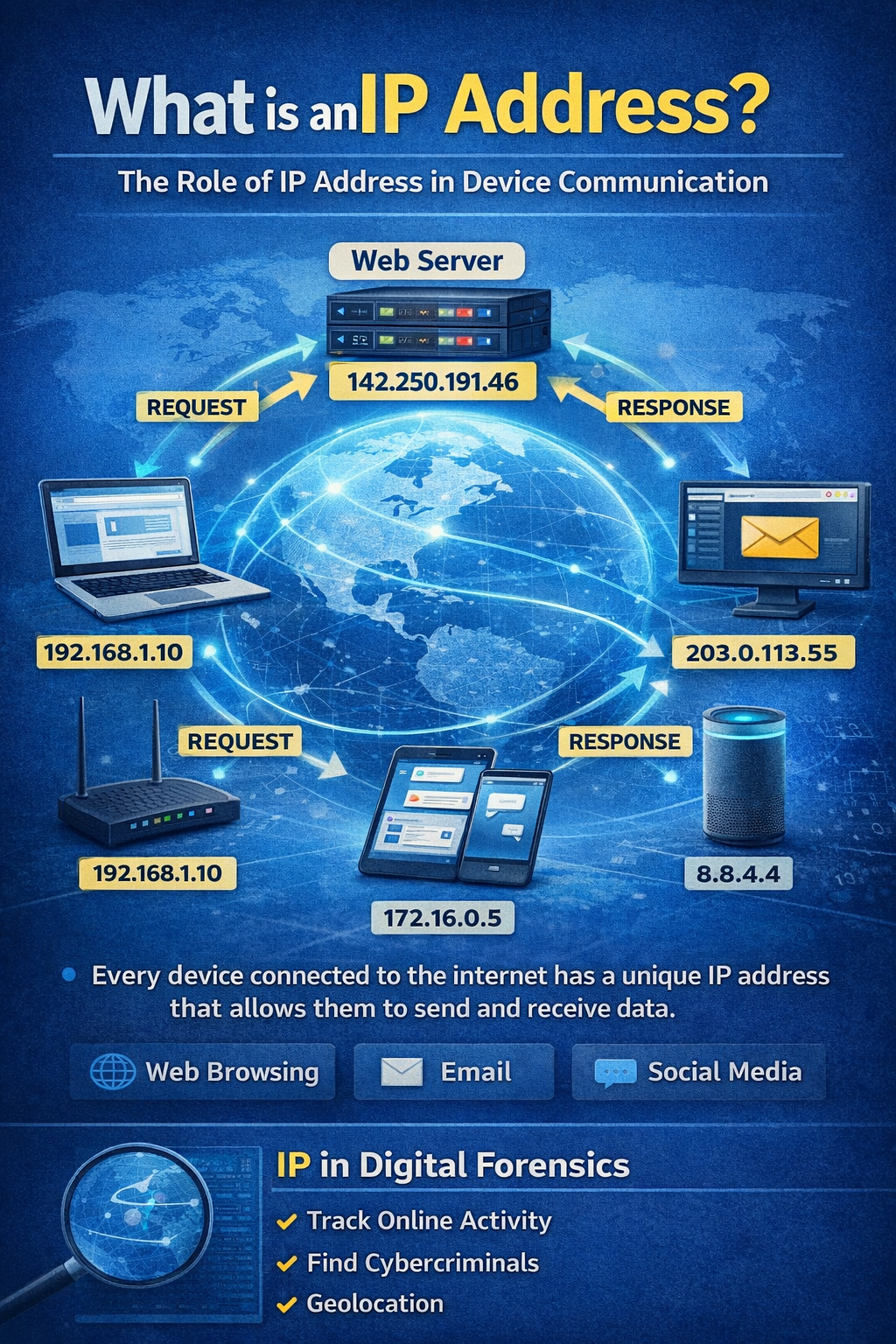
An IP (Internet Protocol) address acts as a unique numerical identifier for every device on a network. In simple terms, it works like a home address and directs data to the correct destination.
Without IP addresses, devices cannot communicate. As a result, the internet cannot function properly.
How Does an IP Address Work?
When you type a website name like google.com, your system cannot interpret it directly. Instead, the Domain Name System (DNS) converts the domain into an IP address.
For example:
google.com → 142.xxx.xxx.xxx
After the conversion, your device sends a request to the server. Then, the server processes the request and returns the data. The website loads in a matter of seconds as a result.
Types of IP Address
1. IPv4 (Internet Protocol Version 4)
IPv4 uses four sets of numbers separated by dots. For instance, 192.168.1.1 is a common IP address format.
It supports around 4.3 billion addresses. However, growing internet usage has exhausted this limit.
2. IPv6 (Internet Protocol Version 6)
To solve this limitation, experts introduced IPv6. Unlike IPv4, it provides a significantly larger pool of addresses.
Additionally, IPv6 improves efficiency and strengthens security. Therefore, it supports the future expansion of the internet.
Public vs Private IP Address
IP addresses also differ based on usage.
Public IP Address
Your Internet service provider assigns a public IP address to your network. As a result, your device can communicate with external systems.
Private IP Address
In contrast, your router assigns private IP addresses to devices within your network. Therefore, these addresses handle internal communication only.
In short, public IPs enable external communication, while private IPs manage internal traffic.
Static vs Dynamic IP Address
IP addresses can also vary based on assignment.
Static IP Address
A static IP address remains fixed over time. Because of this stability, businesses and servers prefer it.
Dynamic IP Address
On the other hand, Internet service providers assign dynamic IP addresses automatically. As a result, they change periodically and enhance user privacy.
IP Address in Digital Forensics
In digital forensics, investigators rely heavily on IP addresses. For example, they trace cyberattacks and analyze suspicious activities using IP logs.
They also examine email headers and monitor server records. Furthermore, experts use IP-based geolocation to estimate user locations.
However, IP addresses alone do not prove anything. Instead, investigators combine them with multiple sources of evidence to build accurate conclusions.
Can IP Addresses Be Hidden?
Users can hide their IP addresses with tools like VPNs, proxy servers, and the Tor network. As a result, tracking becomes more difficult.
However, these tools do not guarantee complete anonymity. In fact, forensic experts can still identify users by analysing additional digital footprints.
Common Misconceptions About IP Addresses
Many people misunderstand how IP addresses work. Here are a few clarifications:
❌ IP shows exact location
✔️ It only provides an approximate location
❌ Changing IP ensures anonymity
✔️ Other digital traces still exist
❌ IP alone proves guilt
✔️ Investigators use it only as supporting evidence
Real-World Relevance
In real cybercrime investigations, experts often begin with an IP address. For instance, they extract it from email headers or server logs.
Next, they contact the ISP to identify the user linked to that IP at a specific time. Consequently, even a simple number can lead to critical evidence.
Conclusion
An IP address forms the foundation of internet communication. It enables devices to connect and exchange data efficiently.
Moreover, digital forensic experts use IP addresses to trace activities and uncover important clues. However, they always combine IP data with other evidence to ensure accuracy.




Post comments (0)