Logical vs Physical Extraction in Mobile Forensics
Mobile phones have become one of the most critical sources of digital evidence in modern investigations. From communication records and location data to application activity and deleted content, smartphones store vast amounts of information. To access this data legally and scientifically, forensic experts rely on extraction techniques. Among these, logical extraction and physical extraction are the two most widely discussed methods in mobile forensics.
Understanding the difference between logical and physical extraction is essential for forensic students, investigators, and legal professionals, as each method serves a distinct purpose and carries specific limitations.
What Is Mobile Forensic Extraction?
Mobile forensic extraction refers to the process of acquiring data from a mobile device in a manner that preserves its integrity and admissibility in court. Investigators must follow proper procedures, use validated tools, and ensure data integrity through hashing and documentation.
Depending on the case requirements, device condition, and legal permissions, examiners choose either logical extraction or physical extraction—or sometimes both.
Logical Extraction in Mobile Forensics
Definition
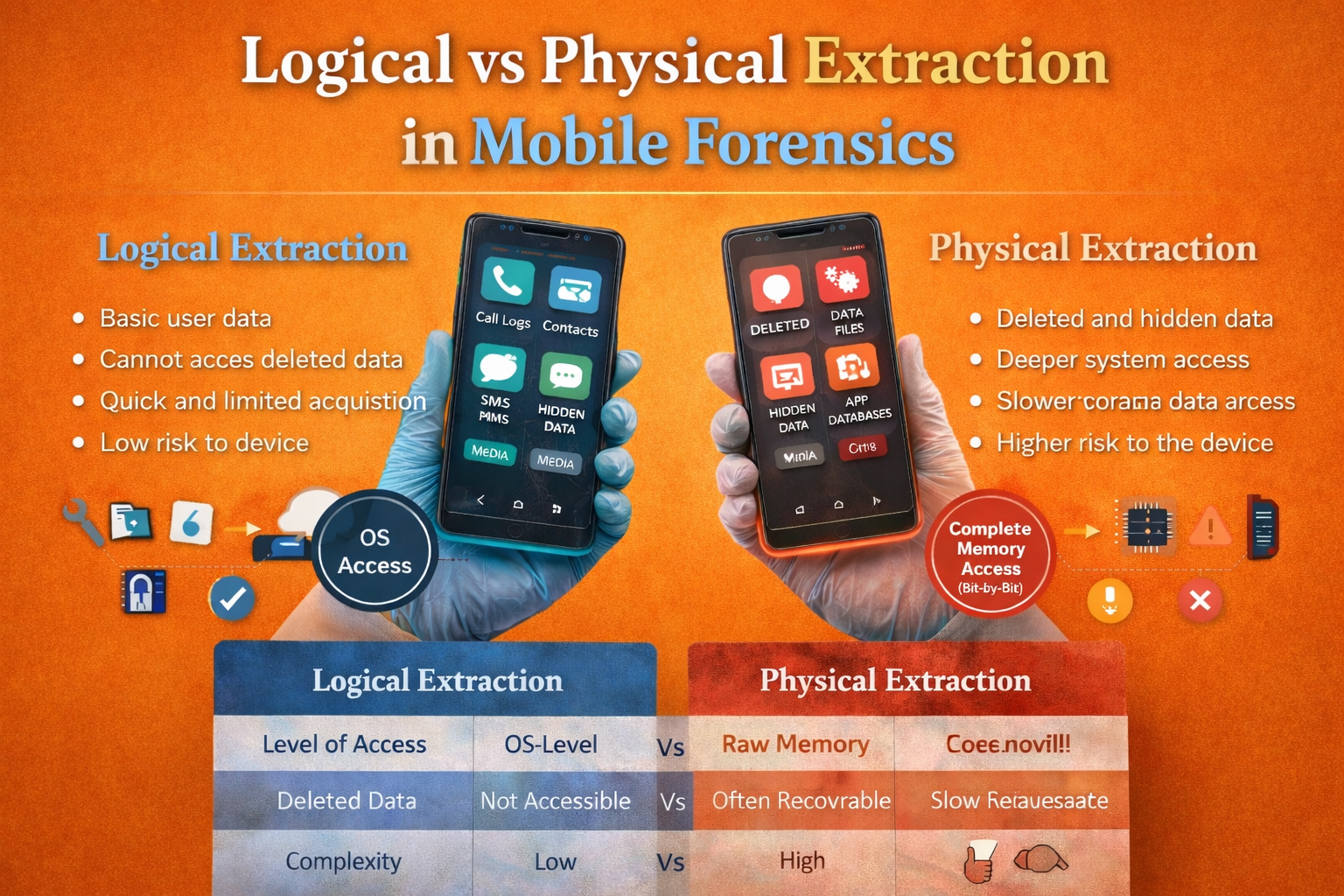
Logical extraction involves acquiring data through the device’s operating system using standard communication protocols. In simple terms, it retrieves data that the phone is willing to share through its software interface.
Types of Data Retrieved
Logical extraction typically allows access to:
However, it usually does not retrieve deleted data or hidden system files.
How Logical Extraction Works
Forensic tools communicate with the device using APIs or backup mechanisms. The tool requests data, and the operating system responds by providing accessible information. As a result, the extraction remains non-invasive and relatively quick.
Advantages of Logical Extraction
-
Faster and easier to perform
-
Minimal risk of damaging the device
-
Suitable for locked or encrypted phones (in some cases)
-
Often sufficient for routine investigations
-
More acceptable in live or time-sensitive cases
Limitations of Logical Extraction
-
Cannot usually access deleted data
-
Limited access to system-level files
-
Dependent on OS restrictions
-
Results vary with device model and OS version
Therefore, logical extraction works best when investigators need readily available user data, not hidden or deleted information.
Physical Extraction in Mobile Forensics
Definition
Physical extraction involves acquiring a bit-by-bit copy of the device’s memory, including both allocated and unallocated space. This method provides a complete snapshot of the device storage.
Types of Data Retrieved
Physical extraction may recover:
Because it accesses raw memory, it offers a deeper level of analysis.
How Physical Extraction Works
Physical extraction may involve advanced techniques such as:
These methods bypass the operating system to access underlying memory directly.
Advantages of Physical Extraction
-
Ability to recover deleted data
-
Access to system and hidden files
-
More comprehensive evidence collection
-
Strong forensic value in serious crimes
Limitations of Physical Extraction
-
Technically complex
-
Time-consuming
-
May not work on heavily encrypted devices
-
Higher risk if performed improperly
-
Requires advanced expertise and authorization
As a result, physical extraction is generally reserved for high-priority or complex cases.
Key Differences Between Logical and Physical Extraction
| Aspect |
Logical Extraction |
Physical Extraction |
| Level of access |
OS-level data |
Raw memory |
| Deleted data |
Usually not available |
Often recoverable |
| Complexity |
Low |
High |
| Time required |
Short |
Longer |
| Risk to device |
Minimal |
Moderate |
| Skill requirement |
Basic to intermediate |
Advanced |
Legal and Practical Considerations
Investigators must choose the extraction method based on:
-
Court permissions
-
Nature of the case
-
Device condition
-
Time constraints
-
Data requirements
Moreover, improper extraction can compromise evidence. For example, attempting a physical extraction without authorization or expertise may damage the device or violate legal protocols. Therefore, forensic professionals must justify their chosen method in reports and testimony.
Which Extraction Method Is Better?
Neither method is universally “better.” Instead, the choice depends on investigative needs.
-
Use logical extraction when time is limited, data needs are basic, or device integrity must remain untouched.
-
Use physical extraction when recovering deleted data is critical or when deep system analysis is required.
In many investigations, examiners perform logical extraction first, followed by physical extraction if necessary and legally permitted.
Importance for Students and Investigators
For forensic students, understanding these extraction methods builds a strong foundation for practical work. For investigators, selecting the correct method ensures reliable evidence and courtroom acceptance.
Mistakes at the extraction stage can render even strong evidence inadmissible. Therefore, knowledge, training, and documentation are as important as the tools used.
Conclusion
Logical and physical extraction represent two essential approaches in mobile forensics. While logical extraction offers speed and safety, physical extraction provides depth and completeness. Both play crucial roles in modern investigations.
Ultimately, effective mobile forensic analysis depends not on the method alone, but on choosing the right method for the right case, supported by proper procedure, legal compliance, and expert skill.




Post comments (0)