Introduction
Re-recording and digital video integrity are critical concerns in forensic investigations. Digital video evidence—such as CCTV footage, body-worn cameras, and mobile recordings—plays a vital role in reconstructing events.
However, when videos are re-recorded instead of properly extracted, their integrity can be compromised. Therefore, understanding how re-recording affects authenticity and hash verification is essential for forensic professionals.
Understanding Digital Video Integrity in Forensics
Digital video integrity refers to preserving the original file without any alteration. This includes:
- File structure
- Encoding parameters
- Metadata
- Binary data
To verify integrity, forensic experts use hashing algorithms like MD5 and SHA-256 (based on a cryptographic hash function).
Even a minor change in data results in a completely different hash value.
What Is Re-Recording in Video Evidence?
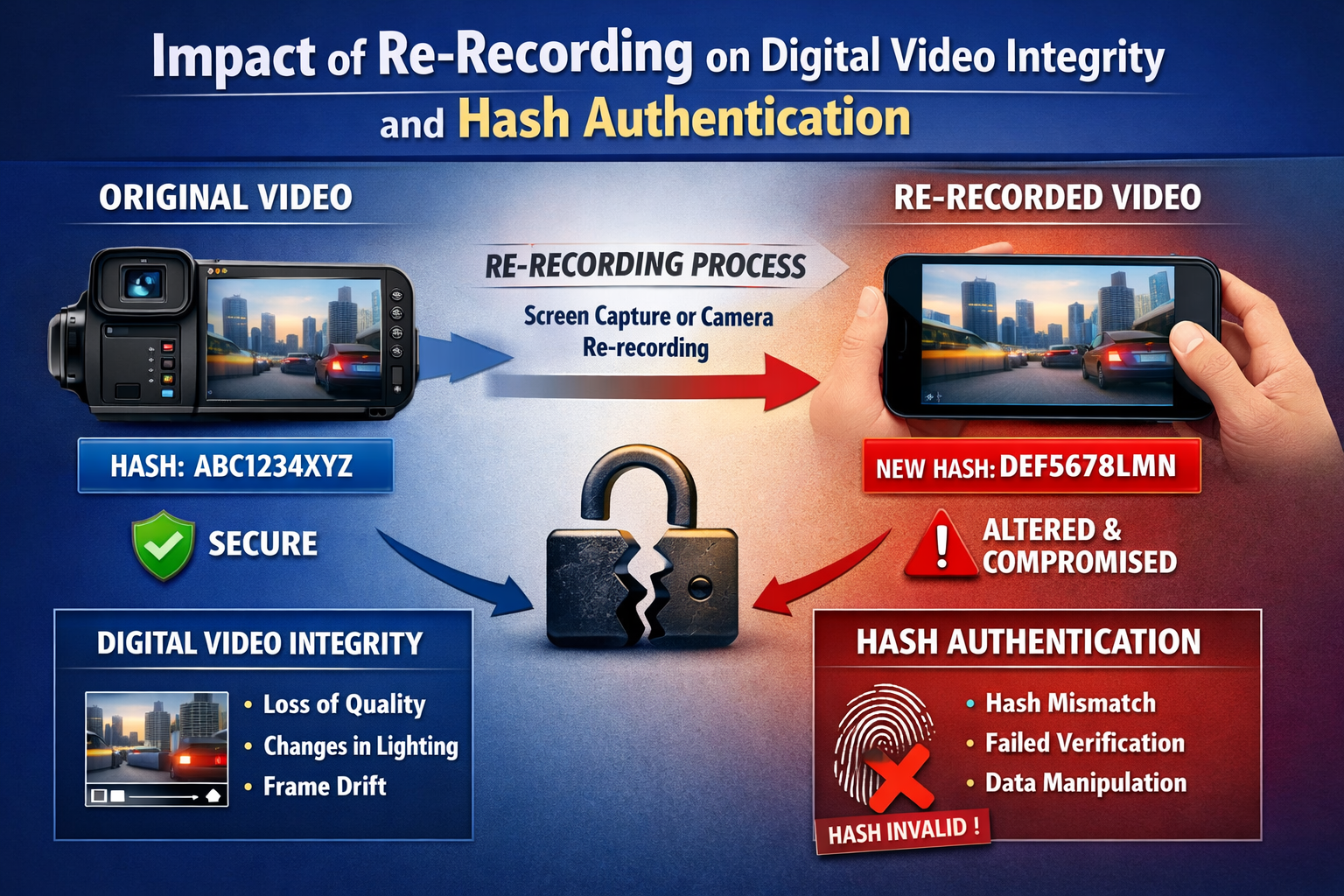
Re-recording occurs when a video is captured again instead of being directly copied.
Common examples:
- Recording CCTV with a phone
- Screen recording playback
- Using external capture devices
This process creates a new file, not the original evidence.
Effects of Re-Recording on Video Integrity
1. Structural Changes in Video Files
Re-recording alters:
- Codec
- Container format
- Compression settings
The new file no longer reflects the original data.
2. Metadata Loss and Alteration
Original metadata such as:
- Creation time
- Device details
- Frame rate
is lost or replaced.
This weakens forensic linkage to time and source.
3. Quality Degradation and Artefacts
Re-recording introduces the following:
- Compression artifacts
- Frame drops
- Resolution changes
These changes are detectable during forensic analysis.
Impact on Hash Authentication
Hash authentication ensures file integrity using algorithms like the following:
However, re-recording changes binary data completely.
Result:
- New hash value generated
- Original hash comparison fails
Therefore, re-recording breaks digital evidence verification.
Chain of Custody Risks
Maintaining a proper chain of custody is essential.
Re-recording introduces risks:
- Breaks continuity of evidence
- Creates doubt about authenticity
- Opens the possibility of tampering claims
This weakens evidentiary reliability in court.
Legal Challenges of Re-Recorded Video
Courts require scientifically verifiable evidence.
Re-recorded videos raise questions like:
- Why wasn’t the original preserved?
- Is any content missing?
- Can timestamps be trusted?
As a result, courts may reduce the evidentiary value or reject the video.
When Re-Recording Is Used
In some cases, investigators may rely on re-recording due to:
- Legacy CCTV systems
- Damaged storage devices
- Urgent documentation needs
However, such use must be properly documented.
Best Practices for Preserving Video Evidence
To maintain integrity:
- Use forensic extraction tools
- Generate hash values immediately
- Preserve original media
- Use re-recording only as a reference
These practices ensure stronger legal admissibility.
Conclusion
Re-recording and digital video integrity are closely linked in forensic science. Even if a video appears unchanged, re-recording alters its underlying data.
As a result:
- Hash authentication fails
- Chain of custody weakens
- Legal challenges increase
Ultimately, preserving original evidence is essential for ensuring trust and admissibility in court.



Post comments (0)