Impact of Re-Recording on Digital Video Integrity and Hash Authentication
Digital video evidence plays a crucial role in modern criminal investigations. Investigators rely on CCTV footage, body-worn camera recordings, and mobile phone videos to reconstruct events accurately. Re-recording digital video integrity directly affects how courts evaluate and trust such evidence. Therefore, forensic professionals must understand how re-recording influences authenticity, verification, and admissibility.
Although re-recorded videos may look unchanged, they often lose their forensic reliability. This loss creates serious challenges during authentication and courtroom examination.
Understanding Digital Video Integrity in Forensic Examination
Digital video integrity ensures that a video file remains unchanged from acquisition to courtroom presentation. Forensic experts define integrity as the preservation of content, file structure, encoding parameters, and metadata.
Even minor alterations can compromise evidentiary value. For this reason, forensic analysts use cryptographic hash values to confirm that digital files remain intact throughout the investigation process.
What Is Re-Recording in Digital Video Evidence?
Re-recording occurs when an investigator captures a video again instead of copying it directly from the original source. Common practices include recording CCTV footage with a mobile phone, screen-recording a playback session, or using an external recording device.
Although these methods preserve visible content, they create an entirely new digital file. Consequently, the resulting video no longer represents the original evidence.
How Re-Recording Affects Digital Video Integrity
Re-recording may appear harmless at first. However, forensic examination reveals several critical integrity issues.
Structural Changes in Re-Recorded Video Files
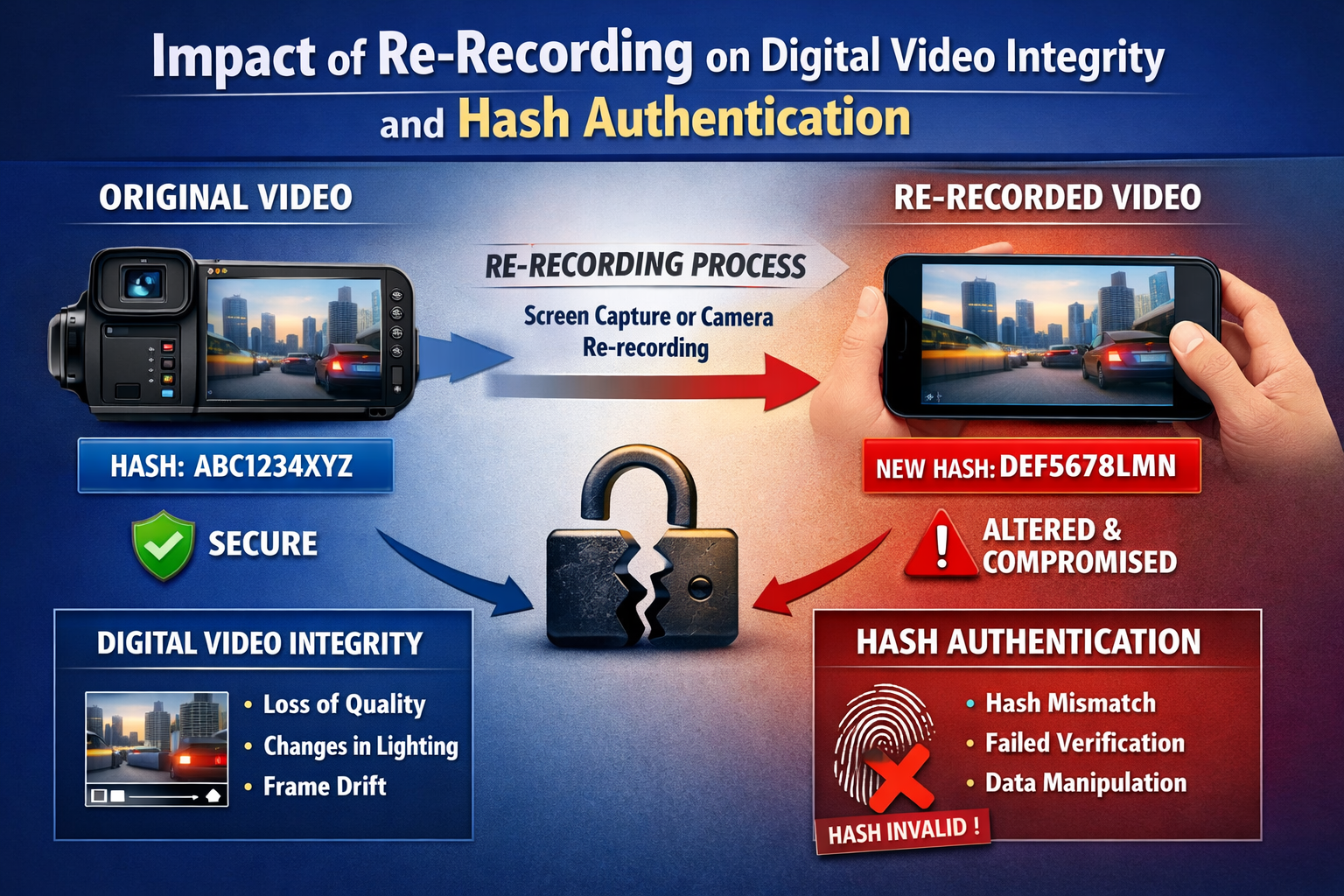
Re-recording destroys the original file structure, including the codec, container format, and compression parameters. The recording device or software applies its own technical settings instead. As a result, the new file fails to reflect the original data accurately.
Metadata Loss and Forensic Consequences
Re-recording removes or replaces original metadata such as creation time, recording device details, frame rate, and resolution. Investigators therefore lose valuable contextual information that could link the video to a specific location, device, or timeline.
Compression Artifacts and Quality Degradation
Re-recording introduces recompression artifacts, resolution scaling, frame drops, and synchronization errors. Although the human eye may not notice these changes, forensic analysis tools can detect them easily.
Impact of Re-Recording on Hash Authentication
Hash authentication forms the backbone of digital evidence verification. Algorithms such as MD5, SHA-1, and SHA-256 generate unique hash values for each digital file.
When re-recording occurs, the binary data changes completely. Consequently, the re-recorded video produces a different hash value. Even if the visual content appears identical, hash comparison will always fail.
Therefore, re-recording digital video integrity prevents forensic experts from proving originality and authenticity.
Chain of Custody Risks in Re-Recorded Video Evidence
The chain of custody documents every stage of evidence handling. Courts require investigators to demonstrate uninterrupted control over digital evidence.
Re-recording breaks this continuity. Investigators cannot prove that the re-recorded file matches the original source. As a result, defense teams can question possible editing, selective recording, or manipulation.
This weakness significantly reduces evidentiary reliability.
Legal Challenges of Re-Recorded Digital Videos
Courts prefer evidence that investigators can authenticate, reproduce, and verify scientifically. Re-recorded videos rarely meet these standards.
During cross-examination, opposing counsel often questions:
-
Why investigators failed to preserve the original file
-
Whether the recording omits critical content
-
Whether metadata and timestamps remain reliable
Because of these concerns, courts may reduce the evidentiary weight or reject the video entirely.
When Investigators Sometimes Use Re-Recording
Despite its limitations, investigators sometimes rely on re-recording due to practical constraints. Legacy CCTV systems may lack export functionality, storage media may suffer damage, or investigators may require immediate documentation at the scene.
Even in these cases, forensic best practices require detailed documentation and transparent disclosure of limitations in the expert report.
Best Practices to Preserve Digital Video Integrity
Forensic professionals can avoid integrity issues by following established protocols:
-
Acquire video evidence through forensic imaging or logical extraction tools
-
Generate and document hash values immediately after acquisition
-
Preserve original storage media whenever possible
-
Use re-recorded videos only as supplementary reference material
These practices protect re-recording digital video integrity and strengthen courtroom defensibility.
Conclusion
Re-recording digital video integrity creates serious forensic and legal challenges. Although re-recorded footage may appear unchanged, it always alters the underlying digital data. Consequently, hash authentication fails, the chain of custody weakens, and legal challenges increase.
Forensic professionals must prioritize direct acquisition methods and educate stakeholders about the risks of re-recording. Ultimately, when investigators cannot demonstrate integrity, courts cannot rely on the evidence.


Post comments (0)