When people think of forensic identification, fingerprints and DNA usually come to mind. However, another fascinating branch of forensic science is chiloscopy, the study and examination of lip prints for personal identification. Just like fingerprints, the grooves and wrinkles present on human lips can provide valuable forensic evidence.
Although chiloscopy is not as widely used as fingerprint or DNA analysis, it has gained increasing attention due to its potential in criminal investigations. Lip prints left on glasses, cups, cigarette butts, clothing, tissue paper, or even skin may help investigators connect a suspect to a crime scene.
What is Chiloscopy?
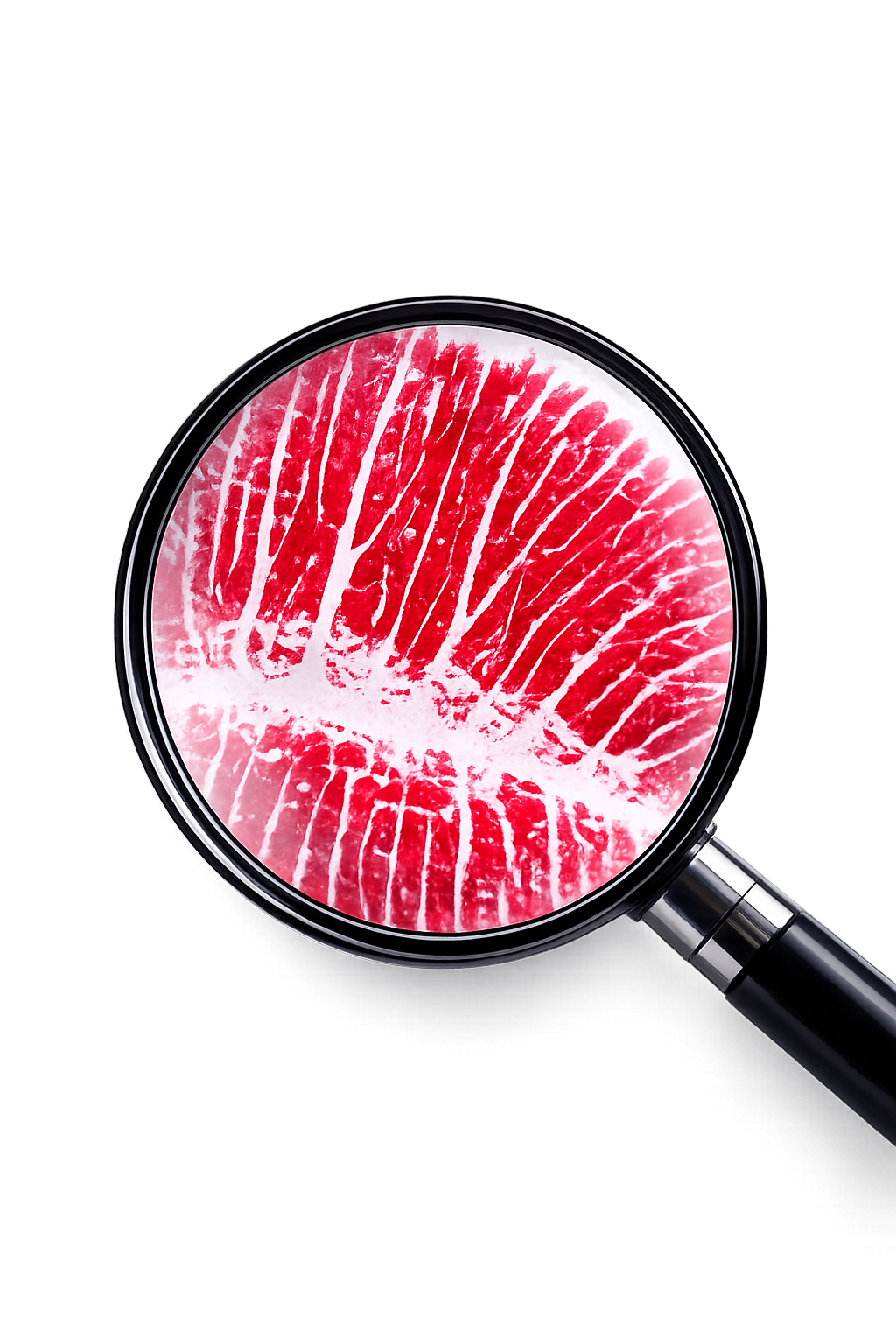
Chiloscopy is the scientific examination, comparison, and interpretation of the grooves, wrinkles, and furrows present on the vermilion border of the lips. These groove patterns are believed to be unique to every individual and remain relatively stable throughout life unless altered by major trauma or surgery.
Forensic experts use these patterns to compare evidence collected from a crime scene with known lip print samples.
Why are Lip Prints Important in Forensics?
Lip prints can serve as physical evidence in situations where fingerprints or DNA are unavailable. During crimes such as burglary, assault, homicide, or sexual offences, a person may unintentionally leave lip impressions on various surfaces.
Lip print evidence can help investigators:
- Associate a suspect with a crime scene.
- Support or contradict witness statements.
- Corroborate other forensic findings.
- Narrow down possible suspects.
- Strengthen the overall investigation when used with other evidence.
While lip prints alone may not always establish identity beyond doubt, they can become an important piece of corroborative forensic evidence.
Characteristics of Lip Prints
Lip prints possess several features that make them valuable in forensic examinations:
- Individual-specific groove patterns.
- Relative permanence over time.
- Availability on multiple types of surfaces.
- Potential to recover latent (invisible) impressions using forensic techniques.
- Useful for comparative analysis with known specimens.
These characteristics make chiloscopy an emerging discipline within forensic identification.
Classification of Lip Print Patterns
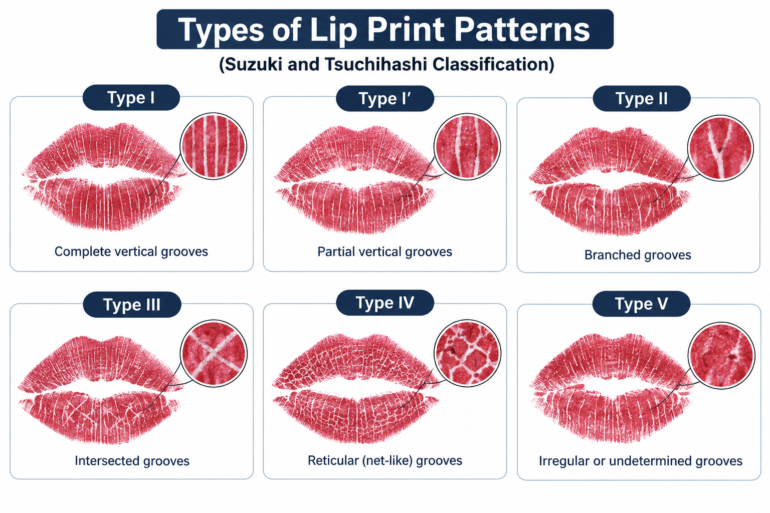
One of the most widely accepted systems is the Suzuki and Tsuchihashi Classification, which divides lip print grooves into six major categories:
- Type I: Complete vertical grooves.
- Type I′: Partial vertical grooves.
- Type II: Branched grooves.
- Type III: Intersected grooves.
- Type IV: Reticular (net-like) grooves.
- Type V: Irregular or undetermined grooves.
During examination, forensic experts identify the dominant pattern and compare multiple regions of the lip print to improve reliability.
Collection of Lip Print Evidence
Proper evidence collection is essential for accurate examination. Depending on the surface, investigators may use different methods to develop visible or latent lip prints.
Common collection techniques include:
- High-resolution forensic photography.
- Transparent lifting tape.
- Fingerprint lifting materials.
- Powder development methods.
- Chemical enhancement techniques for latent impressions.
- Digital imaging and image enhancement software.
Once collected, the evidence is carefully preserved following proper chain of custody procedures before laboratory examination.
Applications of Chiloscopy
Chiloscopy has several practical applications in forensic science:
- Crime scene investigation.
- Personal identification.
- Suspect comparison.
- Disaster victim identification (supportive evidence).
- Academic research in forensic science.
- Training forensic investigators.
Researchers continue to study lip print characteristics to improve identification accuracy and establish standardized examination protocols.
Limitations of Chiloscopy
Like every forensic discipline, chiloscopy has certain limitations.
Factors that may affect lip print quality include:
- Smudging during contact.
- Partial impressions.
- Cosmetic products such as lipstick.
- Dry or cracked lips.
- Pressure differences while making the impression.
- Surface texture and environmental conditions.
Because of these factors, lip print evidence is generally used alongside other forensic evidence rather than as the sole basis for identification.
The Future of Chiloscopy
Modern forensic laboratories are increasingly exploring digital image processing, artificial intelligence, and pattern recognition algorithms to improve lip print analysis. High-resolution imaging and automated comparison systems may enhance accuracy and reduce examiner subjectivity.
As research expands and standardized methodologies develop, chiloscopy has the potential to become a more reliable complementary forensic identification technique.

Post comments (0)