Apple devices such as iPhones and iPads have become an integral part of everyday communication, banking, business, navigation, photography, and social networking. As a result, these devices can contain significant digital evidence relevant to criminal investigations, cybercrime cases, fraud investigations, and civil disputes.
iOS forensics is a specialized branch of mobile device forensics concerned with the identification, preservation, acquisition, examination, and analysis of digital evidence from devices running Apple’s iOS operating system. However, strong encryption and Apple’s security architecture make forensic examination of iOS devices technically challenging.
What Is iOS Forensics?
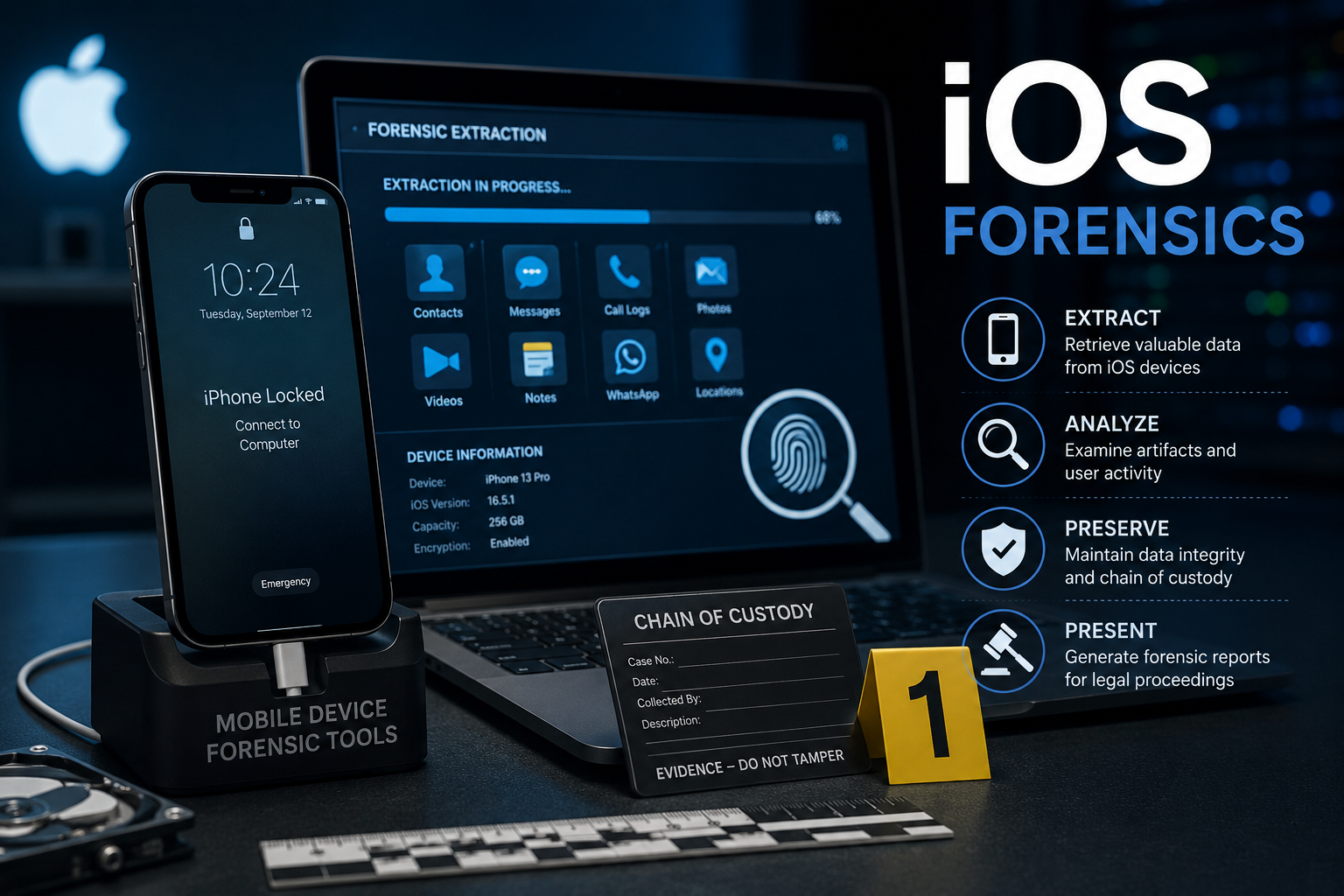
iOS forensics refers to the forensic examination of Apple mobile devices, primarily iPhones and iPads, to identify and recover data that may have evidentiary value.
A forensic investigation may involve data such as call records, contacts, messages, photographs, videos, browser history, application data, location information, Wi-Fi records, documents, and other system artifacts.
Unlike routine data recovery, iPhone forensic investigation must follow established forensic procedures. Investigators should maintain the integrity of the evidence, document their actions, preserve the chain of custody, and use appropriate forensic tools and acquisition methods.
Apple continuously develops security features designed to protect user information. More information about Apple’s platform security architecture is available in the official Apple Platform Security documentation.
Why Is iOS Forensics Important?
An iPhone can provide investigators with a detailed record of a user’s digital activities. Depending on the case, forensic artifacts may help establish communication between individuals, reconstruct a timeline, identify locations, examine internet activity, or correlate events with other digital evidence.
iOS digital forensics can be particularly valuable in investigations involving:
- Cybercrime and online fraud
- Financial and banking fraud
- Harassment and stalking
- Data theft and insider threats
- Missing-person investigations
- Organized crime
- Civil and corporate investigations
- Cases involving social media and messaging applications
However, the existence of an artifact on a device does not automatically establish who performed an activity. Proper forensic interpretation and correlation with other evidence remain essential.
iOS Forensic Acquisition Methods
Data acquisition is one of the most important stages of an iOS forensic investigation. The method available depends on several factors, including the iPhone model, iOS version, security configuration, lock state, forensic tool capabilities, and legal authority.
1. Logical Acquisition
Logical acquisition obtains information through supported interfaces, services, or backup mechanisms. It can provide useful user-level information but may not contain all deleted, protected, or low-level system data.
2. File System Acquisition
A file system acquisition can provide access to a broader collection of files, databases, application information, configuration files, and system artifacts. Where technically supported and lawfully authorized, it can provide investigators with substantially more information than a basic logical extraction.
3. Backup Acquisition
iOS backups can also contain valuable forensic evidence. Depending on how the backup was created and protected, investigators may recover messages, application information, device settings, photographs, and other artifacts.
Apple provides technical information regarding iPhone and iPad backups, which can help in understanding how device data may be stored.
Important Artifacts in iPhone Forensics
During an iPhone forensic analysis, investigators may encounter several categories of artifacts. SQLite databases, property list (.plist) files, application containers, media files, logs, and metadata are particularly important within the iOS ecosystem.
Potential evidence may include call history, SMS and messaging artifacts, contacts, Safari browsing information, photographs and videos, application data, notes, calendar entries, Wi-Fi information, location-related artifacts, and timestamps.
Forensic examiners must interpret these artifacts carefully. A timestamp, database entry, cached record, or location artifact should be examined in its technical context before conclusions are drawn.
Can Deleted Data Be Recovered from an iPhone?
Deleted data recovery from modern iPhones is considerably more complex than it was on older mobile devices. iOS uses sophisticated encryption and data-protection mechanisms that can limit the recovery of deleted information.
In some circumstances, even when original content cannot be recovered directly, traces may remain elsewhere. These may include database records, synchronized information, backups, application caches, notifications, thumbnails, logs, or related metadata.
Therefore, investigators should avoid assuming that either all deleted data can be recovered or that deletion necessarily removes every relevant trace.
Common Tools Used in iOS Forensics
Professional forensic laboratories use specialized tools for iOS forensic extraction and analysis. Depending on authorization, device compatibility, and laboratory requirements, commonly encountered forensic platforms include Cellebrite, Magnet Forensics, and MSAB.
These tools can assist with acquisition, parsing, timeline analysis, application artifact examination, reporting, and correlation of evidence. However, forensic tools should not be treated as infallible. Important findings should be validated, particularly when they are central to the conclusions of an investigation.
Challenges in iOS Forensics
One of the biggest challenges in Apple device forensics is the continuous evolution of iOS security. Device encryption, passcodes, Secure Enclave protections, application sandboxing, hardware differences, and frequent operating-system updates can affect forensic acquisition and analysis.
Cloud-based evidence introduces additional considerations. iCloud data may contain useful information, but its acquisition depends on factors such as lawful authority, account access, authentication controls, data availability, and the investigative circumstances.
Investigators must also ensure that forensic procedures comply with applicable laws and organizational policies before accessing or acquiring device or cloud data.
Maintaining Forensic Integrity
A successful iOS forensic examination is not simply about extracting as much information as possible. Evidence must also be handled in a manner that supports integrity, reproducibility, and proper documentation.
Investigators should document device condition, acquisition methodology, tools and versions used, timestamps, identifiers, and relevant actions taken during the examination. The original evidence should be preserved wherever practicable, and forensic findings should be reported objectively.
Guidance on digital evidence handling can also be found through organizations such as the National Institute of Standards and Technology (NIST).



Post comments (0)