Volatile vs Non-Volatile Data in Digital Forensics
Understanding the Difference That Can Make or Break an Investigation
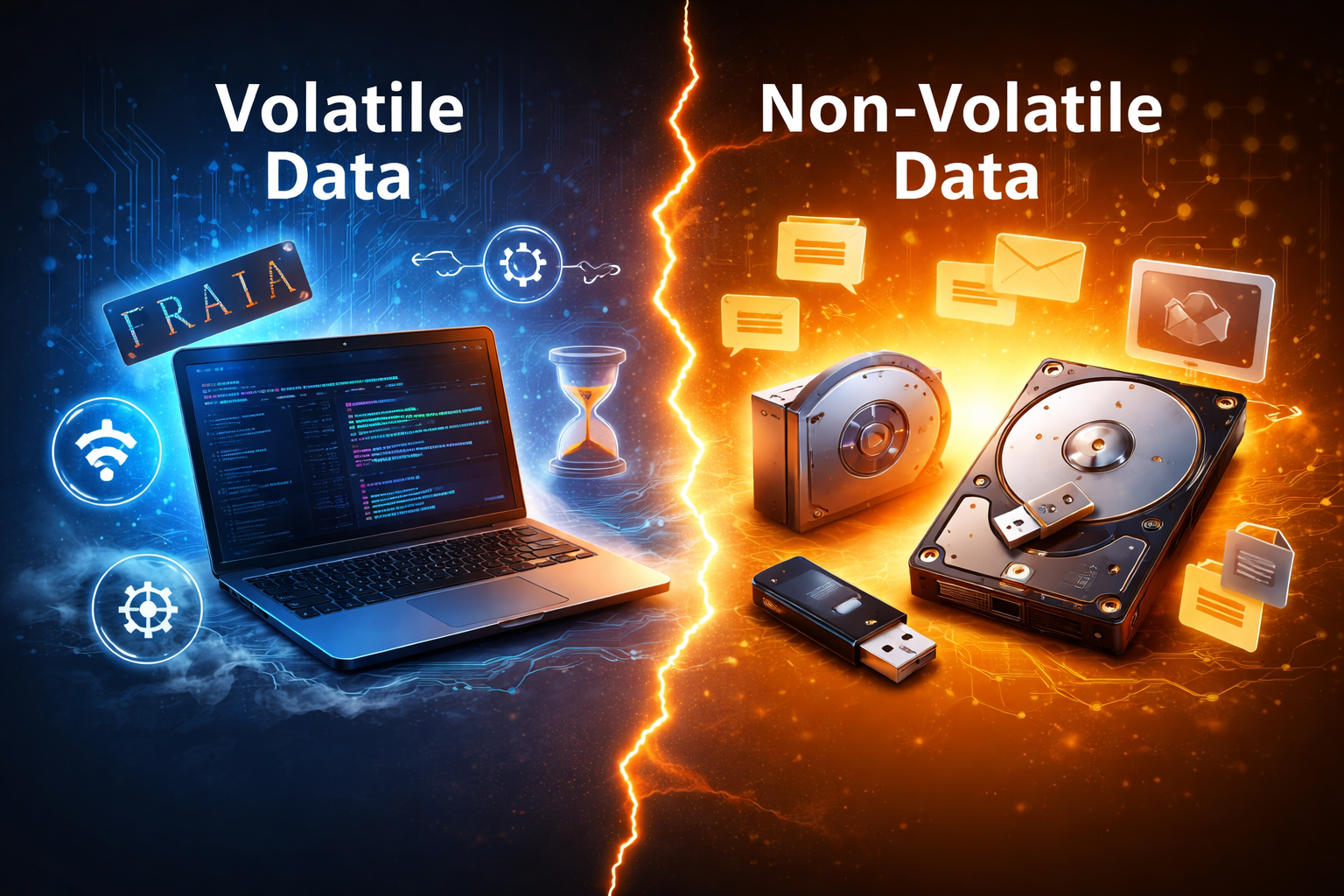
In digital forensic investigations, evidence is not always stored permanently. Some data exists only briefly and disappears the moment a system is powered off, while other data remains stored for months or even years. This fundamental distinction is known as volatile data and non-volatile data.
Understanding the difference between volatile and non-volatile data is crucial for digital forensic experts, incident responders, law enforcement agencies, and even legal professionals. Improper handling or delayed action can result in irreversible loss of critical evidence.
This blog explains what volatile and non-volatile data are, how they differ, and why they are essential in digital forensic investigations.
What Is Volatile Data?
Volatile data refers to information that exists temporarily in a system’s memory and is lost when the system is powered off or restarted. This type of data is highly time-sensitive and must be collected immediately during a live investigation.
Common Examples of Volatile Data
-
RAM (Random Access Memory) contents
-
Running processes and services
-
Active network connections
-
Logged-in users
-
Open files and applications
-
System time and date
-
Encryption keys stored in memory
Once the device is shut down, this data disappears permanently.
Characteristics of Volatile Data
Volatile data often provides insight into what was happening on the system at the time of seizure, making it critical in cybercrime, hacking, malware, and insider threat cases.
What Is Non-Volatile Data?
Non-volatile data refers to information that remains stored even after the system is powered off. This data is usually found on physical or logical storage media and forms the backbone of most traditional forensic examinations.
Common Examples of Non-Volatile Data
-
Hard disk drives (HDD/SSD)
-
Mobile phone storage
-
USB drives and memory cards
-
Emails and documents
-
Browser history and cookies
-
Deleted files (recoverable)
-
System logs and registry files
This data can be acquired even if the device is switched off.
Characteristics of Non-Volatile Data
-
Permanent or semi-permanent
-
Stored on storage devices
-
Stable over time
-
Can be preserved through forensic imaging
-
Suitable for long-term analysis
Non-volatile data helps establish historical activity, timelines, and user behavior patterns.
Key Differences Between Volatile and Non-Volatile Data
| Feature |
Volatile Data |
Non-Volatile Data |
| Storage location |
RAM |
Disk / storage media |
| Persistence |
Temporary |
Permanent |
| Lost on shutdown |
Yes |
No |
| Collection method |
Live acquisition |
Dead acquisition |
| Time sensitivity |
Very high |
Moderate |
| Forensic value |
Real-time activity |
Historical evidence |
Importance in Digital Forensic Investigations
1. Incident Response and Live Analysis
In cyber-attacks, ransomware incidents, or unauthorized access cases, volatile data often reveals:
-
Active malware processes
-
Command-and-control connections
-
Unauthorized user sessions
-
Encryption keys in memory
Without volatile data acquisition, investigators may never identify how the attack occurred or who was responsible.
2. Timeline Reconstruction
Non-volatile data allows forensic experts to:
-
Reconstruct past events
-
Analyze file access and modification
-
Review browsing and communication history
-
Identify deleted or hidden data
Volatile data complements this by showing what was happening at the exact moment of seizure.
3. Malware and Memory Forensics
Advanced malware often operates entirely in memory to avoid detection. Such malware may leave minimal traces on disk but can be identified through volatile memory analysis.
This makes volatile data essential in:
4. Legal and Evidentiary Value
Courts rely on properly collected digital evidence. Volatile data must be:
Non-volatile data is generally easier to defend in court, but volatile evidence can be equally powerful when collected correctly.
Order of Volatility: A Critical Concept
Digital forensic professionals follow the Order of Volatility, which dictates that data most likely to disappear should be collected first.
Typical order:
-
CPU registers & cache
-
RAM
-
Running processes
-
Network connections
-
Temporary files
-
Disk storage
-
Backup media
Failure to follow this order can result in loss of crucial evidence.
Challenges and Limitations
Volatile Data Challenges
-
High risk of alteration during collection
-
Requires live system access
-
May raise legal concerns if mishandled
-
Needs skilled expertise
Non-Volatile Data Challenges
-
Large data volumes
-
Encrypted storage
-
Anti-forensic techniques
-
Time-consuming analysis
Because of these limitations, investigators rely on combined analysis of both data types.
Conclusion
In digital forensics, volatile and non-volatile data serve different but complementary purposes. Volatile data provides a snapshot of live system activity, while non-volatile data offers a historical record of past actions. Ignoring either can weaken an investigation and compromise forensic conclusions.
Successful digital forensic examinations depend on recognizing what data disappears, what remains, and how quickly action must be taken. In many cases, the difference between solving and losing a case lies in understanding this very distinction.



Post comments (0)