Imaging in Digital Forensics: Bit-by-Bit Copy Explained
In digital forensic investigations, accuracy and reliability remain essential. Therefore, investigators must handle digital evidence with extreme caution. Unlike physical evidence, digital data can change instantly. Consequently, forensic experts always preserve data before starting analysis. For this reason, they rely on forensic imaging, which involves creating a precise bit-by-bit copy of the original storage media.
This blog therefore explains forensic imaging in detail, furthermore clarifies the meaning of a bit-by-bit copy, and ultimately highlights its investigative and legal importance.
What Is Imaging in Digital Forensics?
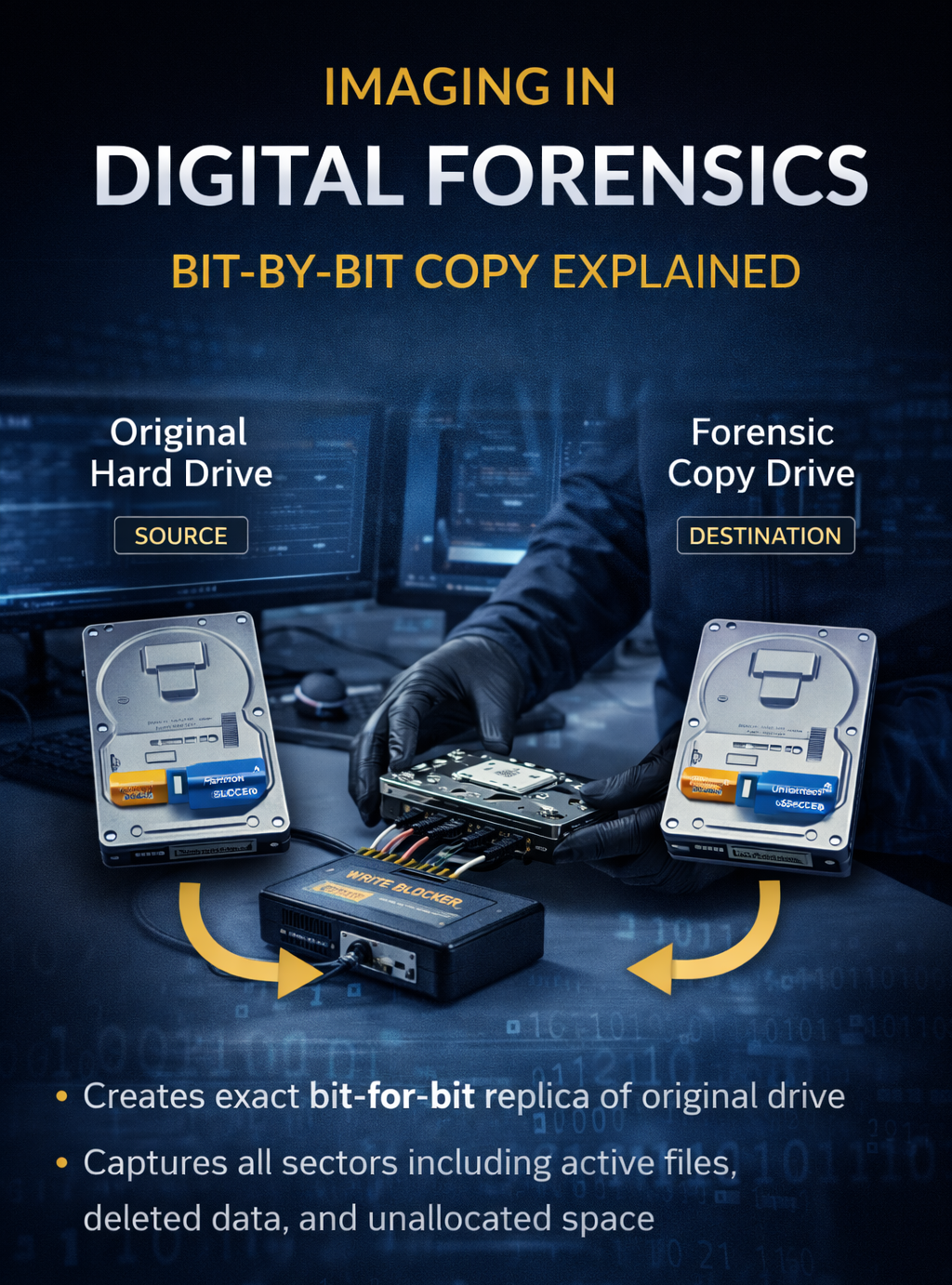
Imaging in digital forensics refers to the creation of an exact digital replica of a storage device such as a hard disk, solid-state drive, USB device, memory card, or mobile phone storage. In practice, investigators call this replica a forensic image.
Unlike ordinary copying methods, forensic imaging captures every part of the storage media. As a result, the forensic image contains:
-
Active files
-
Deleted files
-
Hidden system files
-
Unallocated space
-
Slack space
-
File system metadata
Therefore, investigators gain access to all potential evidence while keeping the original device untouched.
Understanding the Concept of a Bit-by-Bit Copy
A bit-by-bit copy means copying each individual binary digit—every 0 and 1—from the source device to the destination storage. In other words, the forensic image mirrors the original device at the lowest possible data level.
In contrast, a normal copy process transfers only visible files and folders. However, a bit-by-bit copy preserves the complete disk structure. As a consequence, investigators can later analyze deleted data, file fragments, and system artifacts that normal copying would overlook.
Why Bit-by-Bit Imaging Is Essential in Digital Forensics
1. Preservation of Evidence Integrity
Digital forensic principles require investigators to protect original evidence. Therefore, experts perform all examinations on the forensic image instead of the original device. As a result, the original evidence remains preserved and verifiable throughout the investigation.
2. Recovery of Deleted and Hidden Data
When users delete files, the operating system does not erase them immediately. Instead, it marks the space as available. Because of this, bit-by-bit imaging captures those areas. Consequently, forensic tools can recover deleted files and remnants during analysis.
3. Reliability in Court Proceedings
Courts demand proof that digital evidence remains authentic. For this reason, investigators rely on bit-by-bit imaging supported by hash verification. Therefore, experts can confidently present findings during judicial proceedings.
4. Comprehensive Forensic Examination
Many crucial artifacts exist outside visible directories. For example, registry entries and log files often remain hidden. Thus, bit-level imaging allows investigators to locate and analyze such evidence effectively.
Importance of Write Blockers During Imaging
Before imaging begins, investigators connect the storage device through a write blocker. Essentially, a write blocker prevents any data from being written to the source media.
Moreover, write blockers play a critical role because they:
-
Prevent accidental modification
-
Preserve original timestamps
-
Maintain forensic soundness
Without a write blocker, merely connecting a device could change system files. Consequently, courts may question the reliability of the evidence.
Step-by-Step Process of Bit-by-Bit Forensic Imaging
Step 1: Identification and Documentation
First, investigators identify the storage device and document its condition. Additionally, they record the make, model, and serial number. As a result, documentation strengthens the chain of custody.
Step 2: Secure Connection Using Write Blocker
Next, investigators connect the device to a forensic workstation using a certified write blocker. Therefore, the system cannot modify the original evidence.
Step 3: Pre-Imaging Hash Calculation
Before imaging, investigators calculate a cryptographic hash value. In effect, this value serves as the digital fingerprint of the data.
Step 4: Creation of the Forensic Image
Then, investigators use validated forensic tools to create a bit-by-bit image. Commonly, they store images in formats such as RAW (DD), E01, or AFF.
Step 5: Post-Imaging Hash Verification
Finally, investigators calculate the hash value of the forensic image. If the values match, then the copy qualifies as an exact replica.
Role of Hash Values in Forensic Imaging
Hash values form the backbone of forensic integrity. Specifically, even a single-bit change produces a different hash. Therefore, investigators use hash values to confirm data authenticity.
Moreover, hash values:
Accordingly, investigators include hash values in expert opinions and court submissions.
Normal Copy vs Bit-by-Bit Forensic Imaging
| Normal Copy |
Bit-by-Bit Forensic Imaging |
| Copies visible files only |
Copies entire storage media |
| Ignores deleted data |
Preserves deleted and hidden data |
| Alters metadata |
Preserves metadata |
| Lacks verification |
Uses hash-based verification |
Clearly, bit-by-bit forensic imaging provides superior evidentiary value.
Commonly Used Tools for Forensic Imaging
Digital forensic experts commonly rely on validated tools. For example, FTK Imager, EnCase, Autopsy, X-Ways Forensics, and Cellebrite support accurate imaging. Therefore, these tools ensure reliable documentation and repeatable results.
Legal Importance of Bit-by-Bit Imaging
From a legal standpoint, digital evidence must meet strict standards. Specifically, courts examine authenticity, integrity, and continuity. Because bit-by-bit imaging satisfies these requirements, it strengthens expert testimony. Otherwise, improper imaging can lead to evidence rejection.
Conclusion
In conclusion, bit-by-bit imaging forms the foundation of digital forensic investigations. Therefore, it allows investigators to preserve evidence accurately. Moreover, it enables comprehensive examination of visible and hidden data. Ultimately, by using write blockers, hash verification, and validated tools, forensic experts ensure scientific reliability and legal admissibility.


Post comments (0)