From Crime Scene to Court: The Journey of a Forensic Case
Introduction
In modern criminal justice systems, forensic science plays a pivotal role in uncovering the truth. From the moment a crime is reported until the final judgment is delivered in court, forensic evidence acts as a silent witness. However, the journey of a forensic case is complex and methodical. Each stage—crime scene examination, evidence handling, laboratory analysis, reporting, and courtroom testimony—demands precision, integrity, and scientific rigor. This blog traces the complete journey of a forensic case, highlighting how scientific evidence transforms into legally admissible proof.
1. Crime Scene Examination: The Foundation of the Case
The forensic journey begins at the crime scene. A crime scene is not merely a location but a repository of physical clues that can reconstruct events. Therefore, proper scene management is crucial.
First responders secure the scene to prevent contamination or loss of evidence. Subsequently, forensic experts conduct a systematic examination using established protocols. This includes identifying potential evidence such as fingerprints, bloodstains, documents, weapons, digital devices, or trace materials.
Moreover, thorough documentation is essential. Investigators record the scene through notes, sketches, measurements, and forensic photography. Since the crime scene cannot be revisited once altered, accurate documentation ensures that observations remain available throughout the investigation and trial.
2. Evidence Collection and Preservation
Once identified, evidence must be carefully collected. Each item is handled according to its nature—biological, physical, chemical, or digital. For instance, bloodstained articles require air-drying and sterile packaging, while documents must be protected from folding or additional markings.
Equally important is the chain of custody, which documents every transfer of evidence from the scene to the courtroom. Any break in this chain may raise questions about tampering or contamination, potentially rendering evidence inadmissible.
Thus, proper labeling, sealing, and storage are not procedural formalities but legal necessities that safeguard the credibility of forensic findings.
3. Laboratory Examination and Analysis
After collection, evidence is forwarded to a forensic laboratory for scientific examination. This stage varies depending on the discipline involved, such as forensic biology, chemistry, ballistics, digital forensics, or questioned document examination.
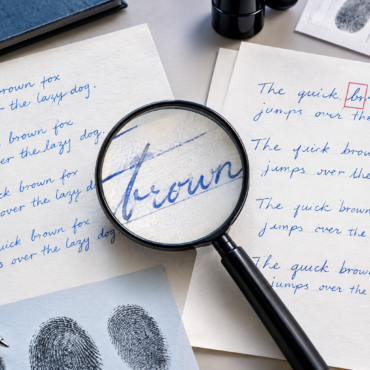
In the laboratory, forensic experts follow validated methodologies and standard operating procedures. For example, a document examiner may analyze handwriting characteristics, ink composition, or alterations, while a DNA analyst interprets genetic profiles.
Importantly, forensic conclusions are based on observation, comparison, and evaluation rather than assumptions. Experts must remain impartial, as their role is to assist the court, not to support either party.
4. Interpretation and Data Analysis
Raw observations alone are insufficient. Therefore, forensic experts interpret findings within the context of the case. This involves assessing similarities, differences, and limitations of the evidence.
For instance, in handwriting examination, natural variation must be distinguished from forgery. Similarly, in DNA analysis, statistical significance plays a key role. Throughout this process, experts consider alternative explanations and acknowledge uncertainties.
Consequently, this analytical stage ensures that conclusions are scientifically sound and defensible under cross-examination.
5. Preparation of the Forensic Report
The forensic report is the bridge between science and law. It communicates complex scientific findings in a structured, clear, and unbiased manner.
Typically, a forensic report includes:
Since judges and lawyers may not possess scientific training, the report must avoid unnecessary jargon while maintaining technical accuracy. A well-drafted report strengthens the probative value of evidence and supports judicial understanding.
6. Submission to Investigating Agency and Court
After completion, the forensic report is submitted to the investigating agency and later produced before the court. At this stage, the report becomes part of the official case record.
Courts evaluate forensic reports based on relevance, reliability, and adherence to legal standards. Therefore, procedural compliance during earlier stages directly impacts the evidentiary value of forensic findings.
7. Expert Testimony in Court
Often, forensic experts are summoned to testify as expert witnesses. During testimony, experts explain their examination process, findings, and opinions under oath.
Cross-examination tests the expert’s competence, methodology, and objectivity. Hence, clarity, consistency, and scientific integrity are critical. An expert must defend conclusions while acknowledging limitations honestly.
Ultimately, expert testimony helps the court interpret scientific evidence correctly and reach informed decisions.
8. Judicial Evaluation and Final Outcome
While forensic evidence is influential, it is not conclusive on its own. Courts assess it alongside witness statements, circumstantial evidence, and legal arguments.
Nevertheless, when properly collected, analyzed, and presented, forensic evidence significantly enhances the pursuit of justice. It can corroborate testimonies, refute false claims, and, in many cases, determine guilt or innocence.
Conclusion
The journey of a forensic case from crime scene to court is a meticulous process governed by science, ethics, and law. Each stage is interconnected, and any lapse can weaken the entire case. Therefore, forensic professionals bear immense responsibility in ensuring accuracy, transparency, and objectivity.
As forensic science continues to evolve, its role in strengthening the criminal justice system becomes even more vital. Understanding this journey not only builds public trust but also highlights why forensic evidence remains one of the most powerful tools in the pursuit of truth.



Post comments (0)